Your Wedding Budget Isn't Broken. But the Way You Built It Might Be
Let me tell you about Sarah and James.
They set a $28,000 budget in January. They were careful. They made a spreadsheet. They felt good about it.
By March, they were at $34,000 — and they hadn't booked a single thing yet.
Nothing dramatic happened. No one made a reckless decision. The florist they loved quoted $400 more than the estimate they'd used. The venue they'd almost decided on got booked by someone else, pushing them toward a pricier option. They waited two weeks to confirm their caterer — and in those two weeks, the Saturday minimum went up.
Small shifts. Quiet pressure. And then suddenly: a budget that no longer made sense.
This is not a rare story. This is most couples.
Before you tour another venue, know the real minimum you're working with.
The Wedding Venue Minimums Tracker → see the tool

The Uncomfortable Truth About Wedding Budget Drift
Most couples don't blow their budget on one extravagant decision. They lose it gradually — in the gap between when they planned and when reality showed up.
Here's what that gap looks like in real life:
You spend six weeks comparing photographers. By the time you're ready to book, your first choice has filled your date. You've lost the vendor and the leverage.
You research florists for a month, then discover the quote you'd been mentally budgeting against was from last season's pricing. The current rate is 15–20% higher.
You delay the venue decision because you're not sure yet — and that delay means you're now choosing from what's left, not what you wanted. Scarcity has replaced strategy.
This isn't carelessness. This is what happens when a fixed plan meets an unfixed process.
Not sure what your wedding should actually cost? Get a realistic number in under 2 minutes. 👉 Try the free Wedding Budget Calculator
Why Waiting Feels Safe — But Isn't
There's a very understandable instinct in wedding planning: if I'm not sure, I'll wait until I'm more sure.
It feels responsible. Measured. Like you're protecting yourself from a decision you'll regret.
But here's what actually happens when you wait:
Top photographers, florists, and caterers book 12–18 months out. Every week you wait is a week someone else is deciding. The couple who booked six months before you didn't get lucky — they just went first.
Vendors rarely announce price increases. You just get a quote that's higher than the one you saw online, or than what your friend paid, or than what you told yourself it would be.
When your date gets closer and spots are gone, you stop choosing what you want and start booking what's available. That's when budgets really break — not from bad decisions, but from no-choice decisions.
Keisha and Marcus thought they had plenty of time. They were 14 months out. But they spent the first four months just exploring — visiting venues without committing, saving florists to Instagram, building spreadsheets without making calls. By the time they were ready to commit, their venue shortlist had gone from nine options to two. Neither was what they'd originally envisioned. The budget they'd built assumed the original nine. It didn't survive the two.
This is often the point where planning starts to lose its shape.
Not all at once. Just gradually — as decisions become more reactive than intentional.
There is a way to move through it differently.
Something more structured. More considered.
Every decision you're reading about affects your bottom line. See exactly how much you have to work with. 👉 Get your free budget breakdown
A Note on the Anxiety — Because I Know It's There
If reading this is making your chest tight, I want to pause and say something important:
This is fixable. And it is not your fault.
Nobody teaches couples how to sequence wedding decisions. Nobody explains that booking your venue before your photographer matters — not just logistically, but financially. Nobody warns you that the category you decide on last often costs the most, because by then you have the least leverage left.
You weren't given the structure. You were just handed a budget number and told to start planning.
Of course it feels unstable. It was built to be.
The anxiety you're feeling isn't a sign that you've done something wrong. It's a signal that the foundation underneath the budget needs attention — not the numbers themselves.
Where Budgets Actually Break — It's Not Where You Think
Most people assume budgets fall apart at the end — in the final months, when everything costs more than expected.
But the break happens early. Before priorities are set. Before tradeoffs are defined. Before the order of decisions is clear.
If you don't know whether your priority is the venue or the photography, you'll spend energy — and mental budget — in both directions while committing to neither. That indecision has a cost. Not just emotionally, but financially.
Tom and Lauren had a $22,000 budget. They spent the first three months doing equal research across every category. No priorities. No sequence. Just open-ended exploration — because it felt fair and thorough.
When they finally started booking, they'd mentally overspent in four categories — none of which were finalized — and had no clear sense of where to pull back. The budget didn't have one breaking point. It had twelve.
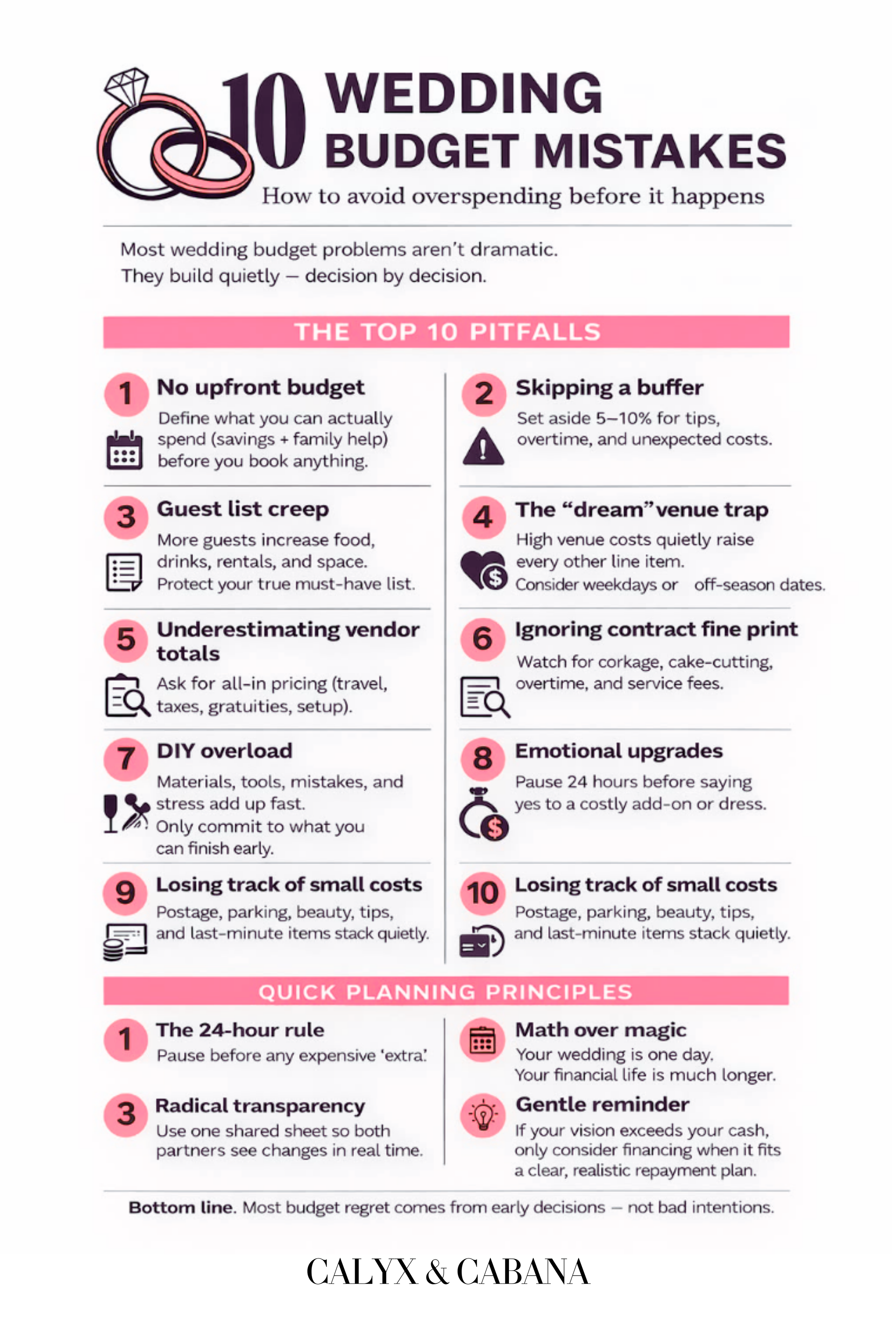
What Actually Stabilizes a Budget
It's not a more detailed spreadsheet. It's not more vendor research. It's not a longer list of maybes to revisit when you're ready.
It's making the right decisions in the right order — before anything gets booked.
When you know which categories carry your vision and which ones you're flexible on, every decision after that gets easier. You stop second-guessing. You stop over-researching. You stop the slow, invisible drift.
You're not reacting to the process anymore. You're leading it.
The couples who recover budget stability mid-planning aren't the ones who cut the most. They're the ones who stopped making undirected decisions and built a sequence they could actually trust.
If the starting point feels unclear, that’s not a personal failure — it’s a structural one.
Most wedding planning advice tells you what to do.
But it doesn’t tell you what to decide first — or how those decisions shape everything that follows.
That’s where things start to drift.
It’s not usually a dramatic mistake. Just small decisions made without enough context — the kind that quietly become expensive later.
When a budget feels shaky, it’s often not the numbers.
It’s the order.
Trying to figure it out as you go almost always leads to that same feeling — something slightly off.
Not a lack of instinct.
The absence of structure.
Before you tour another venue, know the real minimum you're working with.
The Wedding Venue Minimums Tracker → see the tool
If you want to see the full structure — how every decision connects and what actually belongs first — you can explore The Calyx Wedding Collection™ here
—Sara Calyx & Cabana
Related Articles:
Why Most Couples Overspend on Their Wedding Before the First Vendor Is Booked
A Simple Wedding Budgeting Process That Actually Holds Together
7 Budget Mistakes That Are Quietly Wrecking Your Wedding Plans
The 4 Wedding Planning Mistakes That Cost Couples the Most Money (None of Them Are What You Think)
Your Wedding Budget Isn't Broken — But the Way You Built It Might Be
