The 4 Wedding Planning Mistakes That Cost Couples the Most Money (None of Them Are What You Think)
The most expensive wedding planning mistakes don't look like mistakes when you're making them. They look like reasonable decisions, made at a pace that felt appropriate, toward outcomes that seemed fine.
That's what makes them expensive. You don't see them until you're on the other side.
Most of these mistakes don’t come from bad decisions. They come from decisions made too early, without enough context.
Before you tour another venue, know the real minimum you're working with.
The Wedding Venue Minimums Tracker → see the tool
Most wedding planning advice focuses on where to save money. Florist substitutions. Off-peak dates. Buffet instead of plated dinner.
That's not what this is about.
The mistakes that actually cost couples the most money aren't about specific vendors or categories. They're structural. They happen in the first few weeks of planning, before a single deposit is paid, and they quietly shape everything that follows.
I've watched them play out dozens of times. And the most expensive part isn't the mistake itself — it's the cascade of decisions that gets made downstream from it.
Here are the four that matter most.
Mistake One: Booking Vendors Before Setting Parameters
This is by far the most common and the most costly.
A couple gets engaged in October. By November they've found a photographer whose work stops them mid-scroll. It feels like a sign. They book.
Six months later, the photographer's schedule constraints rule out two of the three venues they love. Or the shooting style requires a venue with certain light conditions that only two local options provide. Or the booking deposit — which felt manageable in November — is now sitting as a committed line item while every other budget category is quietly absorbing the pressure.
I know a couple who booked their photographer, their band, and their florist within the first eight weeks of engagement — all based on Instagram, all before they had a venue, a guest count, or a real budget conversation. By the time they sat down to actually plan the wedding, every major creative decision was already made. The venue had to work around the vendors. The budget had to stretch around the deposits already committed.
They didn't end up with a bad wedding. They ended up with a wedding that cost significantly more than they intended and felt slightly like a collection of beautiful things that didn't quite belong together.
Vendors should be chosen in the context of your full picture — your venue, your guest count, your priorities, your real numbers. Not as isolated decisions made in the excitement of early planning.
Every early commitment becomes a variable that constrains every future choice. The more variables you lock in before the picture is clear, the less room you have to make the wedding actually yours.
This is the moment most planning quietly goes off track.
Not because the choice was wrong — but because it was made before the full picture existed.
Mistake Two: Setting a Budget Based on National Averages
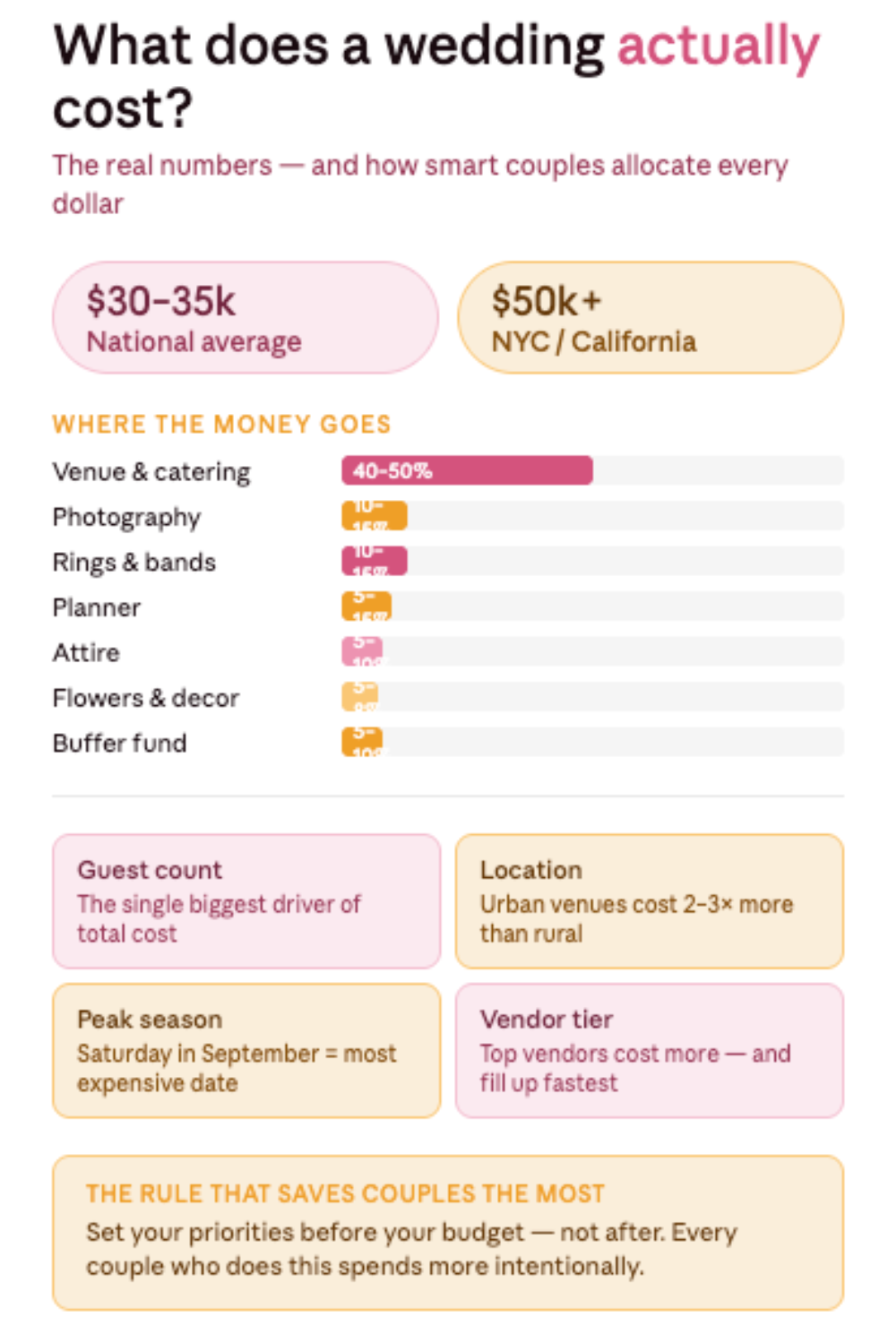
The average wedding cost in the United States is frequently cited at somewhere between $30,000 and $35,000. That number is almost useless.
It blends couples getting married at city hall and couples renting entire estates. It averages Manhattan and rural Missouri. It combines 40-person dinners and 250-person receptions. It mixes vendors who charge $1,500 for photography and vendors who charge $12,000.
The number that results describes almost no one's actual wedding.
I've watched couples build their planning around a national average and then spend the next year adjusting upward as reality arrives — venue quotes come in higher than expected, catering minimums exceed the estimates, florals cost more than the Pinterest-sourced examples suggested. Every adjustment feels like a surprise. The cumulative effect is almost always 20 to 40 percent over where they intended to be.
The couple who starts with "we want to spend around $30,000" because that's what they read online is not wrong to have a number. They're wrong about where the number came from.
Your budget needs to be calibrated to your market, your vendor tier, and your guest count. A 120-person wedding in Chicago with a mid-tier vendor team costs a very different amount than a 120-person wedding in Nashville or Phoenix. The variables that actually determine your number — city, guest count, vendor tier, venue type — are specific to you. The national median is specific to no one.
Build your budget from your reality. Not from a statistic that describes someone else's.
When the number isn’t grounded in reality, every decision after it has to adjust.
This is why the starting point matters more than most couples realize.
Mistake Three: Planning the Wedding Before Deciding What the Wedding Is
This one is the most subtle and, in my experience, the most likely to produce a wedding that looks beautiful and feels slightly hollow.
Most couples think they know what kind of wedding they want before they've actually defined it. They know the aesthetic. They have a mood. They've saved five hundred images to a private Pinterest board. But they haven't answered the structural questions that make a wedding feel like itself:
What is the experience we want guests to have? What is the tone we want the ceremony to carry? What actually matters to us about this day? What are we willing to spend more on — and what genuinely doesn't matter to us at all?
Without those answers, the decisions you make are decorative. They don't connect to anything underneath. And when individual decisions don't connect to a center, the result is a wedding that is technically beautiful but somehow doesn't feel like the two people who planned it.
I think of a couple who spent eight months planning a wedding that looked exactly like what they thought they wanted — romantic, garden-style, candlelit, lush florals — and arrived at the reception feeling slightly disconnected from the room. Not unhappy. Not ungrateful. But quietly aware that the day had been built around an aesthetic rather than around them.
When I talked to them afterward, what came out was that neither of them had actually wanted a large reception. They'd planned one because it felt like the expectation. The aesthetic was genuine. The scale wasn't.
The moment you define the wedding — actually define it, not just feel it — every decision that follows has somewhere to anchor. The guest count becomes obvious. The venue category narrows. The vendor priorities become clear. The budget allocates itself to what actually matters rather than spreading evenly across everything.
Planning without that definition isn't faster. It's just louder.
This is the difference between a wedding that feels cohesive and one that feels slightly off, even when everything is beautiful.
It comes from defining the structure before the details.
Before you tour another venue, know the real minimum you're working with.
The Wedding Venue Minimums Tracker → see the tool
Mistake Four: Skipping the Vendor Vetting Process
Portfolio is not a proxy for professionalism.
Not every vendor who produces beautiful work is a trustworthy business partner. And the couples who end up with vendor problems — missed communication, contract disputes, day-of failures, deposits not returned — almost universally chose based on what they saw, not on how the business operated.
The business indicators matter. Contract clarity. Communication response time and tone. What happens when you ask a direct question. Whether they can provide references and whether those references say anything specific. How they handle the conversation about money. Whether their contract protects you as clearly as it protects them.
I've seen it go wrong in quiet ways and dramatic ways. The photographer who delivered a beautiful gallery but missed the family formals that were the grandmother's one request because no one had walked through the shot list in advance. The caterer who was charming in every meeting and then sent a contract with a clause that essentially allowed them to substitute menu items without notice. The florist who did stunning work but whose communication became increasingly vague in the final six weeks — a pattern that, in retrospect, every one of her previous clients had mentioned if asked.
Asking the right questions before signing isn't about being suspicious. It's about gathering the information that a good vendor will be entirely comfortable providing — and noticing when a vendor isn't.
It doesn't make vendor selection clinical. It makes it smart.
Most vendor problems aren’t about talent.
They’re about choosing without a framework to evaluate what actually matters.
The Pattern Underneath All Four Mistakes
These four mistakes look different on the surface, but they all come from the same place: starting with the visible parts of a wedding before the invisible ones are in place.
Vendors before parameters. Budget before market research. Aesthetics before identity. Portfolio before professionalism.
The couples who plan beautiful, well-budgeted, genuinely personal weddings almost always work in the opposite direction. They build the foundation first — the priorities, the real numbers, the actual definition of what they want — and let the visible decisions follow from that.
The pattern underneath all four mistakes is the same.
Decisions made before the foundation is clear.
Reversing that changes everything — how the budget holds, how vendors fit, how the day ultimately feels.
That’s what the Calyx Wedding Collection™ is designed to do: give you a clear sequence for what to decide first, so everything that follows has somewhere to land.
Before you tour another venue, know the real minimum you're working with.
The Wedding Venue Minimums Tracker → see the tool
— Sara
Calyx & Cabana™
