What Matters Before You Track Anything on a Wedding Planning Spreadsheet
There is a small moment most couples have early on.
It usually happens late in the evening.
One of you opens a blank wedding planning spreadsheet.
The other leans over and says, quietly,
“Let’s just start putting numbers somewhere.”
It feels responsible.
It feels like forward motion.
It feels like relief.
But tracking before clarity creates a strange kind of confidence. You can become very organized…
and still be building in the wrong direction.
In early wedding planning, spreadsheets solve structure.
They do not solve meaning.
And meaning is what quietly shapes every decision that follows.
Most couples don’t need a spreadsheet yet.
They need a place to start.
Before you tour another venue, know the real minimum you're working with.
The Wedding Venue Minimums Tracker → see the tool

The conversation most couples skip before building a wedding budget
Before a single dollar, date, or task belongs in a wedding planning spreadsheet, there is one decision that needs space first.
Not the look of the day.
Not the colors.
Not the mood board.
What this wedding is actually for.
This is the part that often gets rushed because it feels emotional instead of practical.
But later — when pressure shows up — this is the exact conversation couples wish they had slowed down for.
You will feel it when you start facing trade-offs.
When you realize something important does not fit the numbers you created too quickly.
When you start asking, “Is this worth it?” without having named what “worth it” even means for you.
The purpose of the wedding is not a list of values.
It is a single anchor.
A short, honest sentence you can return to when decisions become uncomfortable.
“The most important part of this wedding for us is…”
One sentence.
Not five.
That sentence becomes your editorial lens.
Not because it tells you what to choose. But because it tells you what every future choice should serve.
Why wedding planning spreadsheets backfire when they come first
A wedding planning spreadsheet is very good at telling you what fits.
It is not designed to tell you:
which moments deserve more care
which compromises will quietly sting later
which things you only think you do not care about yet
When couples build structure before meaning, something subtle happens.
Money gets protected in the wrong places.
Time gets compressed where it actually matters most.
Emotional energy gets spent fixing choices that were never wrong — just misaligned.
The spreadsheet did its job.
It followed instructions.
The problem was that the instructions were incomplete.
The quiet starting point that protects the rest of your planning
If you are early in wedding planning, the most useful work you can do right now is not tracking.
It is naming the reason this day exists for you.
Is it about gathering your people in one place?
Is it about creating a once-in-your-life experience?
Is it about intimacy and emotional presence?
Is it about legacy and family continuity?
Is it about celebration and shared energy?
Not all of these can lead.
One must.
This is not about making the right choice.
It is about making your choice visible to yourselves.
Once that anchor exists, your wedding planning spreadsheet becomes powerful instead of persuasive.
It stops shaping your priorities for you.
It starts supporting the ones you already named.
Most of what follows isn’t about fixing decisions.
It’s about making them in the right order.
Not as inspiration.
As direction.
At this stage of planning, it is normal to want something concrete to hold onto.
A file. A tab. A number.
A little space for meaning before structure is not a delay.
It is how you protect the planning version of yourselves you have not reached yet.
Before you tour another venue, know the real minimum you're working with.
The Wedding Venue Minimums Tracker → see the tool
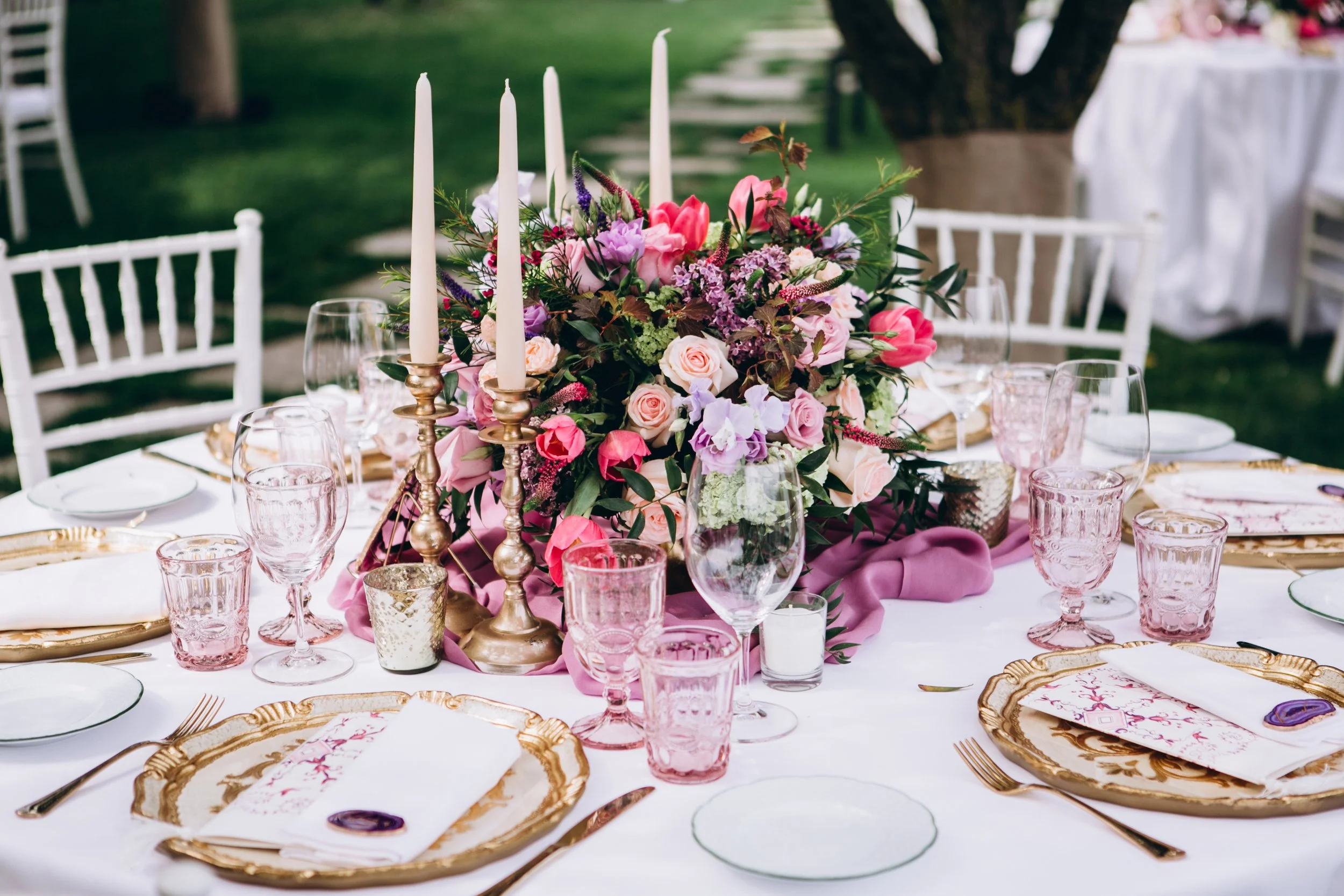
What Should Influence Your Wedding Budget Before You Build It
Most wedding budgets begin the same way.
A blank wedding budget spreadsheet.
A set of familiar category headings.
A long pause before the first number gets typed in.
Venue.
Catering.
Photography.
Florals.
Music.
The list feels neutral.
It is not.
It is simply the way the industry organizes services — not the way couples experience their day.
A good wedding budget is not a list of expenses.
It is a reflection of what you are protecting.
The difference between building a wedding budget and building a wedding experience
Couples rarely talk about their budget in terms of moments.
They talk about vendors.
But when you look back on a wedding, you do not remember categories.
You remember how the ceremony felt.
You remember whether dinner gave you space to breathe or felt rushed.
You remember whether you were pulled in too many directions or able to stay present.
You remember whether the energy carried you through the night — or drained you early.
Your budget does not create those moments on its own.
Your priorities do.
This is where many couples quietly build backward.
They assign money to structure before they define what the structure is meant to protect.
The pressure you most want to avoid should shape your budget
There is another part of budgeting that rarely gets named early enough.
Every budget creates pressure somewhere.
For some couples, the pressure shows up after the wedding — when the financial stretch lingers longer than expected.
For others, it shows up inside family relationships.
For others, it shows up in time, energy, and burnout during planning.
If you do not decide which pressure you are trying hardest to avoid, your budget will decide for you.
Not intentionally.
Automatically.
You will feel this later when something starts to crack — and you cannot quite explain why the numbers feel right but the process feels heavy.
The trade-offs you think you are comfortable with are not always the real ones
Early in planning, it is easy to say you do not care about something.
Decor.
Photos.
Details.
Extras.
The difficulty is not honesty.
It is imagination.
You have not yet seen what those choices look like in real form.
You have not yet experienced what it feels like to stand inside the version of the day created by those reductions.
This is why the most protective budgeting conversations happen before numbers exist.
Not because you need perfect answers.
But because you need to distinguish between what you would happily simplify…
and what you would quietly mourn later.
A wedding budget built without that awareness becomes reactive.
You move money late.
You loosen limits under pressure.
You fix decisions instead of supporting them.
Why this step quietly protects your money
When couples build a wedding budget before clarifying moments, pressure, and real trade-offs, the budget becomes a container for stress instead of a support for experience.
When they build it afterward, something steadier happens.
The numbers stop arguing with the plan.
They begin to express it.
Inside the Calyx & Cabana planning structure, budget work only begins after priorities and pressure points are named.
Not to slow couples down.
But to prevent the most expensive part of planning — rebuilding after momentum is already in motion.
If you are standing at the edge of your first wedding budget spreadsheet, this is a gentle place to pause.
Not because you are behind.
Because you are exactly at the moment where a small amount of clarity saves a great deal of correction later.

What Wedding Planning Decisions Affect Other Decisions More Than You Realize
One of the most disorienting feelings in wedding planning is realizing that something you decided months ago is now quietly controlling what is still possible.
It does not feel fair.
It feels hidden.
Most couples assume each decision stands on its own.
It rarely does.
Some wedding decisions behave like anchors, not options
In planning, certain choices do more than resolve a question.
They shape the entire system that follows.
Guest count is one of them.
It reaches into venue availability, catering minimums, layout flexibility, transportation needs, staffing, rentals, and budget distribution.
Changing it later is not just emotional.
It is structural.
Location and venue type behave the same way.
A venue does not simply host your wedding.
It defines vendor access, design limitations, weather contingency, timeline flow, sound restrictions, setup windows, and guest movement.
When couples say they are choosing a space, what they are really choosing is a planning environment.
A system.
→ The best time to read this is before you do anything else.
Your experience scale quietly controls complexity
Another anchor hides inside language that feels harmless.
“We want it to feel intimate.”
“We want it to feel like a big celebration.”
“We want it to be meaningful.”
Those phrases point to very different operational realities.
A slow, emotionally focused wedding behaves differently from a multi-moment, production-style event.
It changes how your timeline needs to breathe.
It changes how many moving parts must be managed at once.
It changes how many people are required behind the scenes to make the experience feel effortless.
Many later frustrations are not caused by poor planning.
They are caused by underestimating which early choices were structural.
Why this matters so early in wedding planning
When anchor decisions are treated as casual, couples are surprised later when:
the budget feels tighter than expected
the timeline becomes compressed
design options narrow
logistics multiply
Nothing went wrong.
The system simply did what the anchors told it to do.
Inside the Calyx & Cabana approach, one of the earliest layers of planning is identifying which decisions function as anchors — not to restrict couples, but to place those anchors deliberately.
So that the structure supports the experience you actually want.
Not the one you accidentally locked in before you understood how much weight the decision carried.
If planning feels increasingly constrained instead of clearer, this is often the reason.
Not because you chose badly.
Because you were never shown which choices were quietly shaping all the others.
What Order Protects You From Regret in Wedding Planning
Most wedding regret does not come from bad taste.
It does not come from lack of effort.
It comes from sequence.
Couples commit before they clarify.
And then spend the rest of planning adjusting around that early momentum.
Regret is usually an order problem
Venues, dates, vendors, and deposits feel stabilizing.
They create something concrete.
They give the sense that planning has finally started.
But clarity is not created by commitment.
It is created by reflection and sequencing.
The mistake is subtle.
It is not choosing the wrong thing.
It is choosing before you have named what the choice is meant to support.
The order that quietly protects couples from re-planning
When you step back and look at where planning most often unravels, a pattern appears.
Couples who feel steady later almost always begin with three internal layers before touching structure.
They clarify what this wedding is for.
They define boundaries — financial, emotional, time-based, and relational.
They decide the scale and experience they are willing to hold.
Only then do they select the format that can carry those decisions — the location, venue type, and overall flow.
This is not a checklist.
It is a stabilizing sequence.
When the order holds, vendor selection becomes far more calm.
Not because choices are easier.
But because the context is already settled.
Why this order reduces second-guessing
Most late-night wedding doubts sound the same.
“Did we move too fast?”
“Should we change direction now?”
“Are we missing something important?”
Those questions usually appear when decisions are not anchored to prior agreement.
When the internal structure is built first, couples stop needing reassurance from outside sources.
They recognize alignment when they see it.
Confidence does not come from speed.
It comes from coherence.
This is not about slowing down planning
It is about protecting yourself from rebuilding later.
Re-planning is heavier than pausing early.
Not only financially.
Emotionally.
You don’t need to build the whole plan today.
But the order you begin in will shape everything that follows.
Before you tour another venue, know the real minimum you're working with.
The Wedding Venue Minimums Tracker → see the tool
If you want to see the full structure — how every decision connects and what actually belongs first — you can explore The Calyx Wedding Collection™ here
— Sara
Calyx & Cabana™
