
The Recession Is Coming — Here's How to Protect Your Wedding Budget
If you're reading this because something about your budget already feels off — trust that instinct. The Wedding Planning Jumpstart shows you what to lock in before prices move again. → Get it here first, then keep reading.
Let's not sugarcoat this.
Prices are up. Vendors are booking faster. And that "reasonable" number you wrote down six months ago is starting to feel like a rough suggestion rather than an actual plan.
You're not imagining it. And you're not bad at math.
The economy is shifting, and wedding budgets — most of which were never built to handle uncertainty in the first place — are feeling it first.
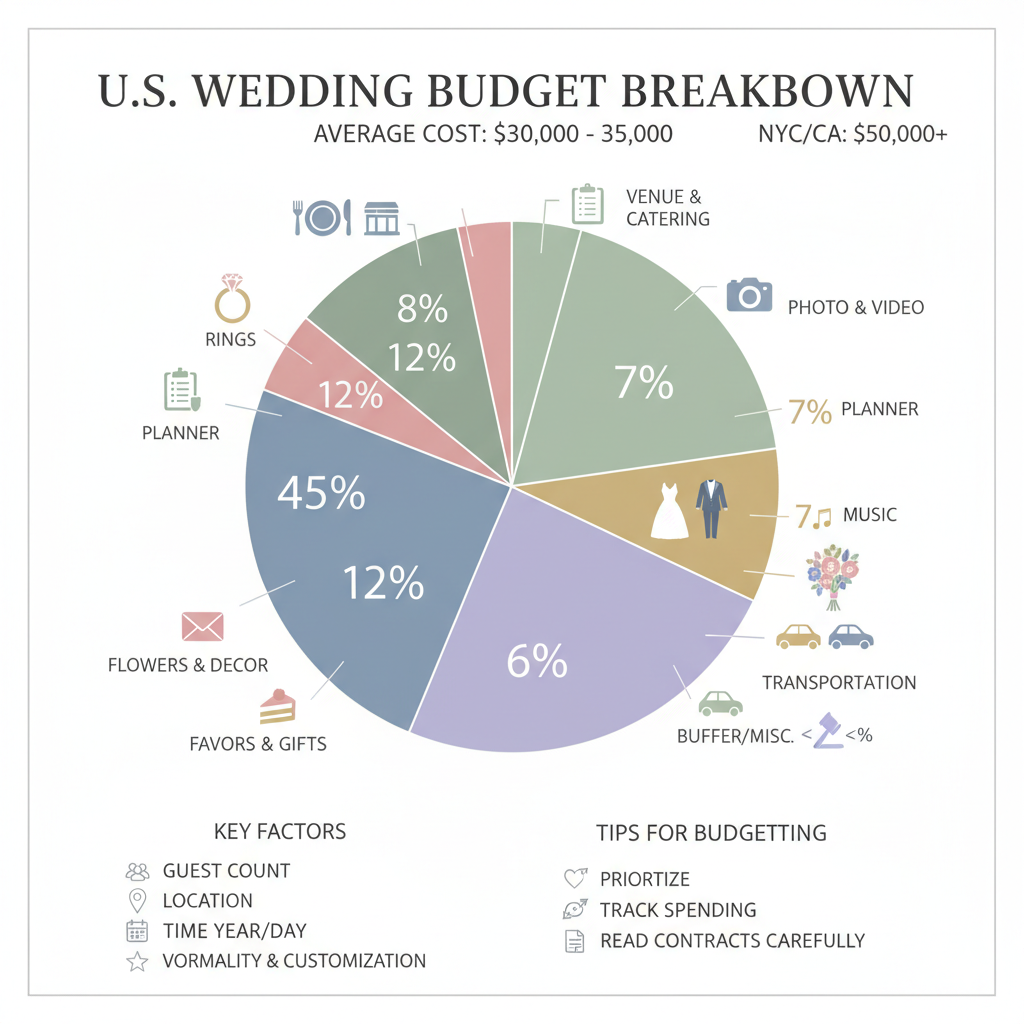
What's Actually Happening Right Now
A caterer in Austin just raised her minimum by 22% since last year. A florist in London is quoting six-month lead times for peak season. A rental company in Chicago is charging a fuel surcharge that didn't exist in 2023.
None of these couples saw it coming. Not because they weren't paying attention — because they built their budgets assuming the world would stay still.
It didn't.
And here's the part that stings: the couples getting hit hardest right now aren't the ones who spent too much. They're the ones who planned too loosely. Who put off the big decisions. Who assumed they had more time.
They didn't.
The Checklist Budget Is a Trap
Most couples build their budget the same way.
Open a spreadsheet. Write down every category they can think of. Attach a number to each one. Add it up. Panic slightly. Remove the photo booth. Feel better.
It looks organised. It is not organised.
Here's why: a checklist budget treats every line item as equal. It doesn't tell you which decisions drive all the others. It doesn't account for timing, trade-offs, or the fact that one "small" change — adding fifteen people to the guest list, upgrading to a Friday-to-Sunday venue package, choosing a photographer in the next tier up — can quietly restructure everything below it.
One couple I know spent three months comparing centrepiece options. Candles vs. flowers. Tall vs. low. Hired a florist. Changed their mind. Hired a different florist. By the time they finalised that decision, their venue had introduced a new minimum spend requirement that added $4,000 to their total. They'd been so focused on the centrepieces that they missed the thing that actually moved the number.
That's what a checklist budget does to you. It keeps you busy in the wrong places.
5 Things That Actually Protect Your Budget When Everything Feels Uncertain

1. Decide what matters before you look at a single price
This sounds obvious. Nobody does it.
Most couples start by browsing — venues, dresses, photographers — and then decide what matters based on what they fall in love with. Which means their priorities are being set by the market, not by them.
One couple sat down before doing any research and wrote a list: the food needs to be exceptional, the photos need to last, everything else is negotiable. That single conversation saved them from spending $3,000 on a floral arch they would have bought if they'd seen it first — because once they had their list, they could look at it and say that's not on here.
Do this first. Before the Instagram rabbit hole. Before the venue tours. Before the florist consultations.
Because once you've seen the $8,000 arch, you can't unsee it.
2. Lock in your biggest cost drivers as early as humanly possible
Guest count and venue. That's it. Those two decisions shape everything else — catering, rentals, staffing, cake size, table count, parking, bathrooms if you're doing outdoor. Everything downstream responds to them.
In an uncertain market, delaying these decisions is one of the most expensive things you can do.
A couple in Melbourne waited four months to confirm their venue because they couldn't agree on the guest list. By the time they were ready, their first choice had booked out and their second choice had raised prices by $3,500. The disagreement cost them real money — not in what they spent, but in what they lost access to.
Have the guest list conversation early. Have it honestly. Have it before you fall in love with a venue that only works for 80 people when your family alone is 75.
Feeling like your budget already doesn’t quite make sense?
Most couples aren’t missing effort—they’re missing structure.
I share the exact decision frameworks, planning sequences, and behind-the-scenes strategy most couples never see (but wish they had earlier).
→ Join the newsletter for calm, structured wedding planning guidance
3. Build a buffer and actually leave it alone
Ten to fifteen percent. Set it aside. Do not touch it for upgrades. Do not use it to say yes to the thing you couldn't quite afford. Leave it for the stuff you didn't see coming.
Because something will come up. It always does.
A couple in New York had budgeted meticulously — every line item accounted for, every vendor confirmed. Three weeks before the wedding, their transport company went out of business. Overnight. Just gone. Replacing them at short notice cost $1,800 more than the original booking. They had a buffer. It was annoying but manageable.
The couple who got married the same weekend and had no buffer? They borrowed money from her parents. At the three-week mark. Right before their wedding.
Build the buffer. Leave it alone.
Order—not effort—is what keeps a wedding on track.
Explore The Calyx System™ →
https://www.calyxandcabana.com/the-system
4. Be brutally honest about DIY
DIY is not a budget strategy in an uncertain economy. It is a time and stress strategy that sometimes saves money — and often doesn't.
The couples doing DIY florals are buying flowers two days out, storing them in spare fridges, recruiting their bridesmaids as free labour, and praying the peonies hold. Sometimes they do. Sometimes a bride is photographed holding what looks like a slightly sad garnish because the heat got to them.
The couples spending eleven weekends making hand-tied favour bags are not saving money when you account for their time, the materials, the backup materials they bought when the first lot didn't look right, and the storage unit they rented for two months to house everything.
DIY works — but only for things that are low stakes, low skill, and well away from the wedding day itself. Paper goods? Yes. Your own bouquet? Please don't.
5. Make decisions earlier than feels necessary
The most expensive place to make a wedding decision is under pressure.
Every time you delay a decision, your options shrink and your prices go up. Vendors book out. Minimums increase. The thing you were going to think about next month isn't available next month.
A photographer I know raised her prices twice last year — once in March, once in September. Both couples who booked in April and October respectively paid the new rate. The couple who enquired in February, asked for time to think, and came back in May paid $600 more than they would have two months earlier.
The time you spend "not quite ready to decide" is not free. It has a cost. It just doesn't show up on your invoice.
The Goal Isn't Spending Less. It's Building Something That Holds
A recession-proof wedding budget isn't a small one. It's a structured one.
It has clear priorities so you know where to hold firm and where to flex. It has a buffer so surprises don't become emergencies. It has a sequence so each decision builds on the last instead of undermining it.
The couples who come out of this planning period without regret aren't the ones who cut the most. They're the ones who decided intentionally — early, in the right order, with a framework underneath them.
That framework is the whole thing.
Start Here
If your budget feels shaky and you're not sure why — it's probably not the numbers. It's the order.
The Wedding Planning Jumpstart gives you the sequence before the decisions start stacking up against you. → Get it here before the next decision locks.
And if you want this kind of thinking landing in your inbox regularly — the Calyx & Cabana newsletter comes with the Wedding Planning Decision Map free. → Join here.
— Sara Calyx & Cabana™
