How Couples Accidentally Overspend $5–15K on Their Wedding
Before you tour another venue, know the real minimum you're working with.
The Wedding Venue Minimums Tracker → see the tool
At the start of wedding planning, it rarely feels like you are making financial decisions.
You are choosing a space you love.
You are sketching a guest list.
You are saving vendors.
You are imagining how the day might feel.
No one shows you the full picture.

Weddings Unravel in the Beginning — Not the End.
You are asked to make decisions one at a time — your wedding venue, your guest count, your design direction, your vendors — without being shown how tightly those choices are connected.
Each decision feels manageable on its own.
Only later do you begin to feel the weight of how many things were bundled inside each yes.
This is why wedding budgets rarely fall apart all at once.
They leak.
A little here.
A little there.
An upgrade that felt worth it.
A decision that felt necessary in the moment.
And then one day, you look at your wedding budget spreadsheet and realize you are five thousand… ten thousand… sometimes fifteen thousand dollars beyond where you thought you would land.
Still unsure how it happened.
Only that it did.
This is one of the quiet realities of modern wedding planning.
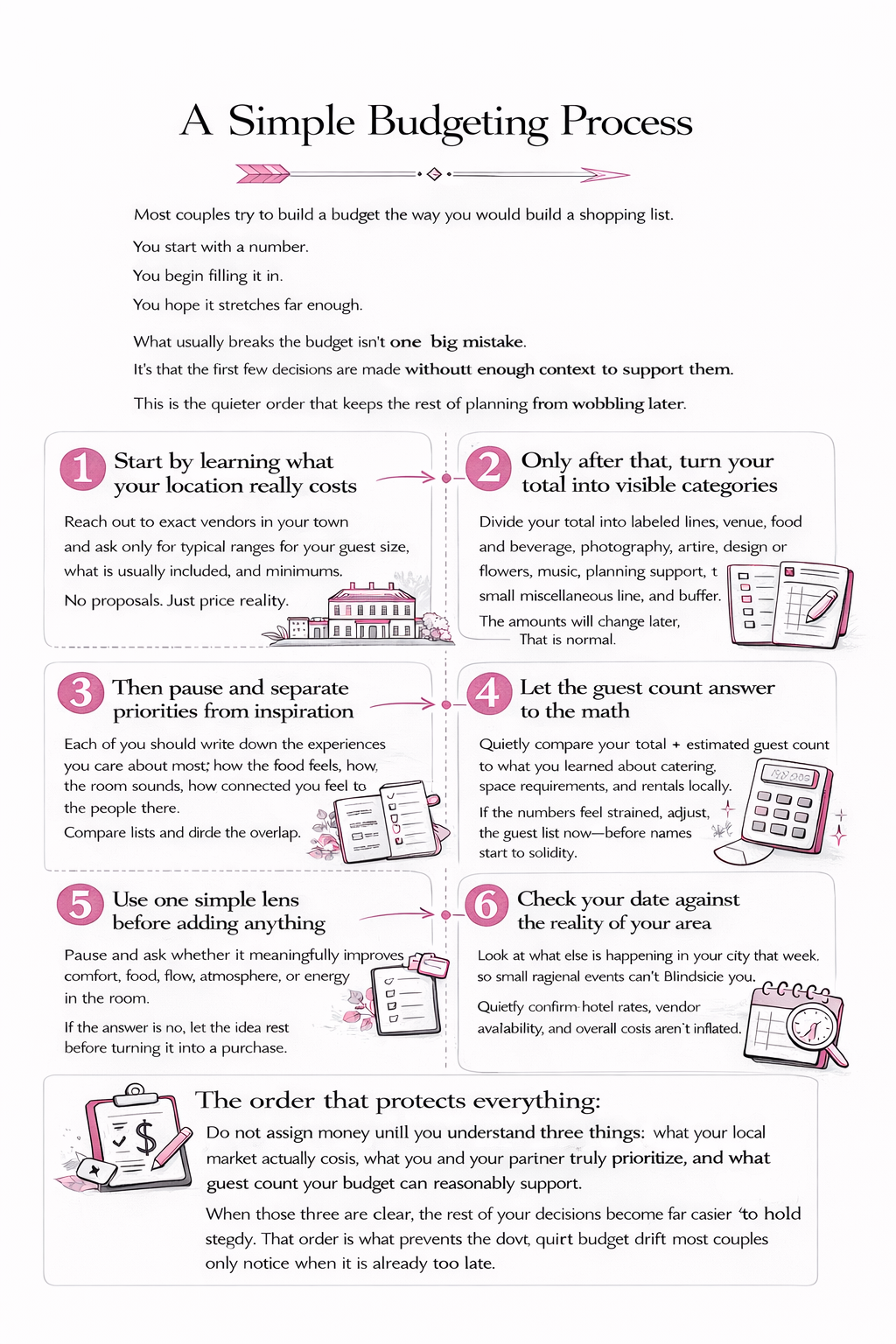
If this is the moment you’re in — where the numbers no longer quite make sense — it’s usually not the spending.
It’s the order behind it.
What This Looks Like in Real Wedding Planning
The wedding venue that quietly changed everything
You book your wedding venue.
It feels like a major milestone.
It also feels like relief.
The price seems reasonable.
The space fits your vision.
You can finally say something is locked in.
What is harder to see in that moment is how much structure comes with the venue itself.
A certain guest capacity.
Specific rental windows.
Staffing requirements.
Set-up and breakdown rules.
Catering models that are already implied.
None of this is hidden.
It simply does not look like a wedding budget decision yet.
Weeks later, catering proposals arrive higher than expected.
Rental lists appear.
Your timeline stretches.
Transportation becomes necessary.
Everything suddenly feels more expensive.
Nothing went wrong.
You did not choose the wrong venue.
You just could not see how many downstream decisions were packaged inside that one early commitment.
Couples who stay steadier with their wedding budgets do not avoid beautiful venues.
They understand what a venue choice commits them to before other decisions start stacking on top of it.
“It’s Only a Little More” — Again and Again
Wedding planning is full of quiet moments like this.
This upgrade actually matters to us.
It is not that much more.
At this point, what is another few hundred dollars?
Each decision feels thoughtful.
None feel reckless.
But wedding budgets rarely stretch because of one large splurge.
They stretch because many reasonable upgrades are layered together.
Couples who stay closer to their intended wedding budget are not less intentional.
They pause long enough to ask a steadier question.
How many of these small additions are we already carrying?
That pause alone often saves thousands.
Not by cutting meaning.
By noticing accumulation.
The Guest List Grew Without Anyone Noticing
Most couples begin with a rough number.
It feels realistic.
Then someone asks about parents’ friends.
Then coworkers come up.
Then extended family.
Then the people who would be hurt not to be included.
Each addition feels socially reasonable.
The guest list grows quietly.
What is harder to see is how far that number travels inside a wedding budget.
Food and beverage.
Rentals and table counts.
Staffing levels.
Transportation.
Stationery and postage.
Guest count is not just a line on a planning worksheet.
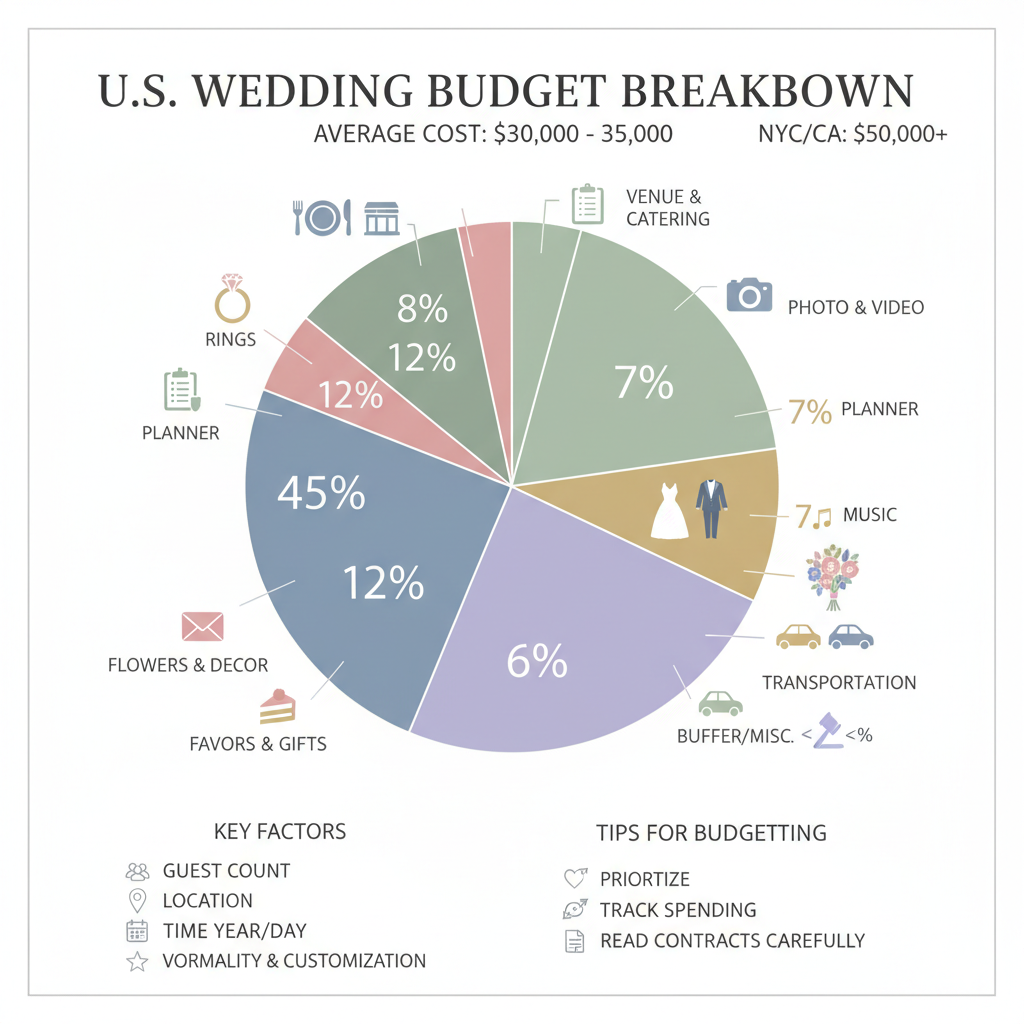
It is one of the strongest wedding budget drivers in the entire planning process.
Couples who protect five to fifteen thousand dollars in spending do not treat the guest list as a moral test or a popularity contest.
They treat it gently — and honestly — as a structural decision.
Before you tour another venue, know the real minimum you're working with.
The Wedding Venue Minimums Tracker → see the tool
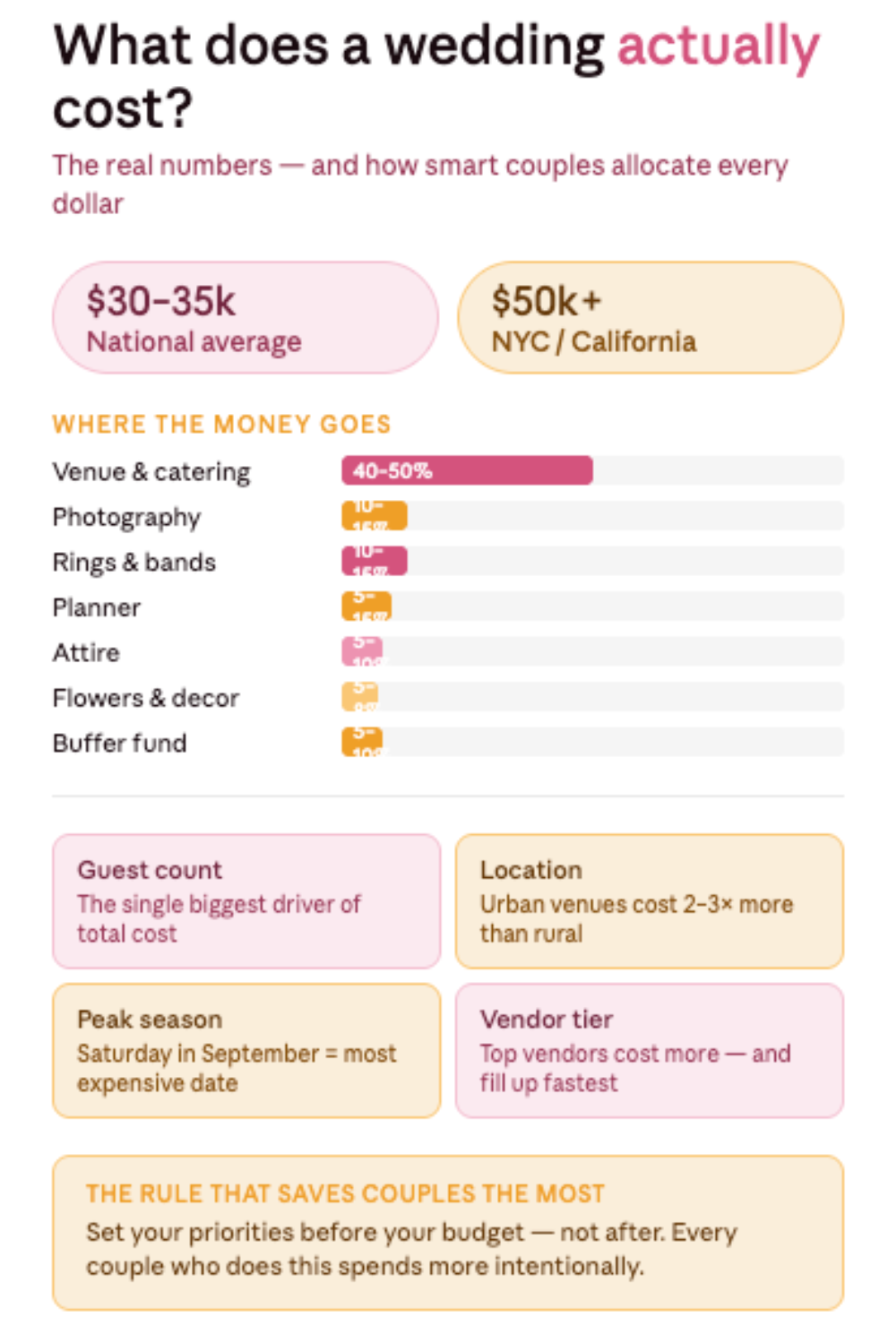
The Real Difference Between Overspending and Staying Grounded
Couples who stay grounded in their wedding budgets are not doing less.
They are not settling.
They are not removing meaning.
They are not planning smaller lives.
They are simply making decisions in a different order.
They understand that a small set of early wedding planning choices quietly shapes hundreds of later expenses.
Guest count.
Venue type and location.
Season and timing.
Level of formality.
How much work will be outsourced versus handled themselves.
These are not line items.
They are the framework that the entire wedding budget must follow.
Seeing that structure early changes everything.
Why This Can’t be Fixed with Wedding Budgeting Tips
There is no shortage of wedding budget advice online.
DIY ideas.
Things to skip.
Ways to negotiate.
Vendor hacks.
Cost-saving checklists.
Some of it is useful.
None of it repairs a planning process that is already working against you.
What actually protects a wedding budget is understanding how decisions connect.
How guest count affects design.
How design affects vendors.
How vendors affect staffing.
How timing affects availability and pricing.
How the venue controls the entire cost structure.
That kind of clarity does not fit into a list of tips.
It comes from seeing your wedding as a system.
Not as a collection of purchases.
If you are early in wedding planning and your budget already feels slippery — even before you have spent very much — this is not a personal failure.
It is the moment most couples reach before they are shown how connected their decisions really are.
Inside the Calyx & Cabana planning structure, this is the stage where early wedding budget drivers, priorities, and sequencing are placed before any commitments are made.
Not to restrict what you choose.
To protect what your choices will quietly require later.
This part of planning is more delicate than it looks.
Wanting a clearer structure before more decisions pile on is not hesitation.
It is care for the version of your wedding — and your finances — that you are still building.and how to avoid it without losing your mind)
Most couples don’t overspend because they’re careless.
They overspend because wedding planning is confusing in ways no one prepares you for.
You start out excited. You save inspiration. You make a few early decisions that feel joyful and harmless. And then, somewhere along the way, the numbers start creeping up.
Nothing dramatic happens.
There’s no moment where you say, “We completely messed this up.”
Instead, it’s a quiet realization:
“Everything costs more than we expected.”
“We’re spending more than we planned.”
“How did this get so expensive so fast?”
If that’s where you are, it’s important to hear this first:
You didn’t do anything wrong.
What’s happening isn’t about discipline or willpower. It’s about how wedding planning works — and how easy it is to make perfectly reasonable decisions in an order that quietly works against you.
Most Overspending Doesn’t Come from Luxury Choices
Your wedding budget is not slipping because you are doing something wrong.
It is slipping because no one showed you the map.
Every couple who stays grounded — who arrives at their wedding day without that quiet, sinking feeling that everything cost more than it should have — started in the same place you are right now.
They just got the sequence right before the commitments stacked up.
That sequence exists.
It is not complicated.
It simply has to come first.
If you are ready to see it — start with The First Decision. Nine dollars. Everything in the right order.
Before you tour another venue, know the real minimum you're working with.
The Wedding Venue Minimums Tracker → see the tool
— Sara
Calyx & Cabana™
