When Everything Is on Fire, Make Something Beautiful
On planning a wedding in a world that won't hold still
There is a particular cruelty to getting engaged right now.
You said yes. You're in love. You want to celebrate — maybe the most deliberately joyful thing a person can do. And the world is on fire.
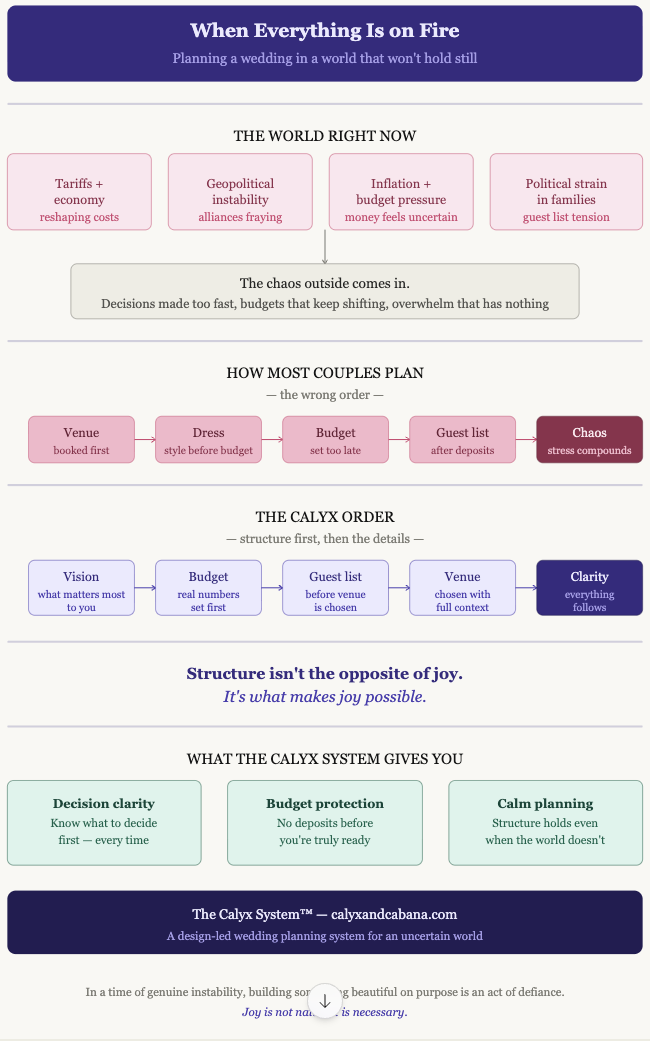
Not metaphorically. Tariffs are reshaping the cost of everything in real time — flowers, catering, the dress, the venue. Geopolitical alliances that held for seventy years are visibly fraying. Inflation restructured how ordinary people think about money and then just... stayed. The news cycle is so relentlessly destabilizing that most people I know have simply stopped reading it — not from apathy, but from self-preservation. And family dinners have become navigational exercises in ways they simply weren't a decade ago.
And into all of that, you are trying to plan a wedding.
I've been doing this work — designing spaces, organizing systems, helping people build beautiful things under complicated circumstances — for forty years. I've watched a lot of couples start this process. And what I'm seeing right now is different. The overwhelm arrives earlier, goes deeper, and has very little to do with the actual wedding.
The chaos outside doesn't stay outside
It comes in.
It shows up as a budget conversation that keeps shifting because the economy keeps shifting. It shows up as a guest list that feels impossible because family relationships are strained in ways that have nothing to do with seating charts. It shows up as vendors booked too quickly, out of fear that prices will keep rising or that the good ones will disappear. It shows up as a kind of low-grade dread that follows you around — the feeling that you're already behind, that you're doing it wrong, that everyone else has this figured out and you don't.
Here's what I want you to know: you are not doing it wrong. You've just been handed the wrong starting point.
Most wedding planning advice was written for a different moment. A moment when the primary challenge was logistics, not decision-making under genuine financial pressure. A moment when inspiration was the scarce resource, not clarity.
Right now, clarity is the scarce resource. And most of what you're being handed — the Pinterest boards, the vendor emails, the "12-month checklist" — is not designed to give you clarity. It's designed to give you more content to consume.
What order does
I have spent forty years helping people bring structure to complex, meaningful projects — homes, gardens, events, lives. What I have learned, over and over, is this: when everything feels chaotic, the most powerful thing you can do is not work harder. It is decide in the right order.
Most couples walk into wedding planning and immediately make the decisions that feel exciting — venues, dresses, florals, tables. These are the decisions that Pinterest was built for. They are also, in many cases, the wrong decisions to make first.
A venue booked before you've agreed on a guest count is a venue that may not fit your actual wedding. A budget set before you understand what drives cost is a budget that will be wrong. Design decisions made before you've established a visual direction are decisions you'll revisit three times.
And in a world that is already asking you to absorb constant uncertainty, the last thing you need is a planning process that compounds that uncertainty with decisions made out of order.
→ Get Your Priorities Clear Before You Book Anything — [Get The First Decision — $9]
Joy is serious business
There is a version of this essay that tells you to ignore the news, focus on love, and not let the world ruin your day. I am not going to write that essay.
The world is not a backdrop. It is the context in which your wedding exists. The tariffs are real. The anxiety is real. The budget pressure is real. The political strain at the family dinner table is real.
What I want to say instead is this: taking your celebration seriously — planning it with intention, structure, and clarity — is not a retreat from the world. It is a response to it.
In a time of genuine instability, building something beautiful on purpose is an act of defiance. Not against anything specific. Against the general drift toward chaos. Against the feeling that nothing can be held, that nothing is solid, that joy is naive.
It is not naive. It is necessary.
→ Get The Decision Map — FreeThe sequence of every wedding planning decision, from engagement through wedding day. Know what comes first before you do anything else.
What I've learned from watching weddings come together — and fall apart
The most beautiful, stress-free weddings I've ever seen were not the ones with the biggest budgets. They were not the ones with the most vendors or the most elaborate details.
They were the ones where the couple had made the right decisions before anyone picked up a contract.
A couple I know nearly signed a $12,000 deposit on a venue before they'd ever actually talked about whether they wanted a big wedding or an elopement. They were in love with the space. They'd toured it twice. They had the paperwork in front of them.
And then they had the conversation they'd been avoiding — about what they actually wanted, what they could actually afford, what kind of day would actually feel like them — and they realized they completely disagreed.
That conversation saved them $12,000 and six months of planning the wrong wedding.
The venue was beautiful. The order was wrong.
What the right order actually looks like
Before venues. Before vendors. Before deposits.
You define what matters. Not in a Pinterest-board way — in a real way. What kind of day do you actually want? Who needs to be there? What would make you feel like yourselves?
Then you establish what you can actually spend. Not what you wish you could spend, and not what you're afraid you'll have to spend. What is real, and workable, given the world as it actually is right now — the interest rates, the vendor prices, the family dynamics, all of it.
Then you decide on a guest count. Then you choose a venue that fits the wedding you've actually described, with the budget you've actually set, for the people you've actually invited.
Then you plan.
That sequence — vision, then budget, then guest count, then venue, then everything else — is not a bureaucratic exercise. It is how you protect the wedding you actually want from the chaos, the opinions, the vendor pressure, and the general noise of a world that will keep being on fire regardless of your RSVP deadline.
I've watched couples who planned this way. They weren't calmer because they had more money or fewer opinions at the family table. They were calmer because they knew what they were building and why, before anyone asked them to sign anything.
That knowledge is available to you. It just has to come first.
Structure isn't the opposite of joy. It's what makes joy possible.
The Calyx System™ was built for exactly this moment — a design-led wedding planning system with guided frameworks, tools, and decision support, for couples who want their celebration to feel intentional even when everything else feels uncertain.
calyxandcabana.com