Why Most Wedding Budgets Go Wrong Before You Book Anything
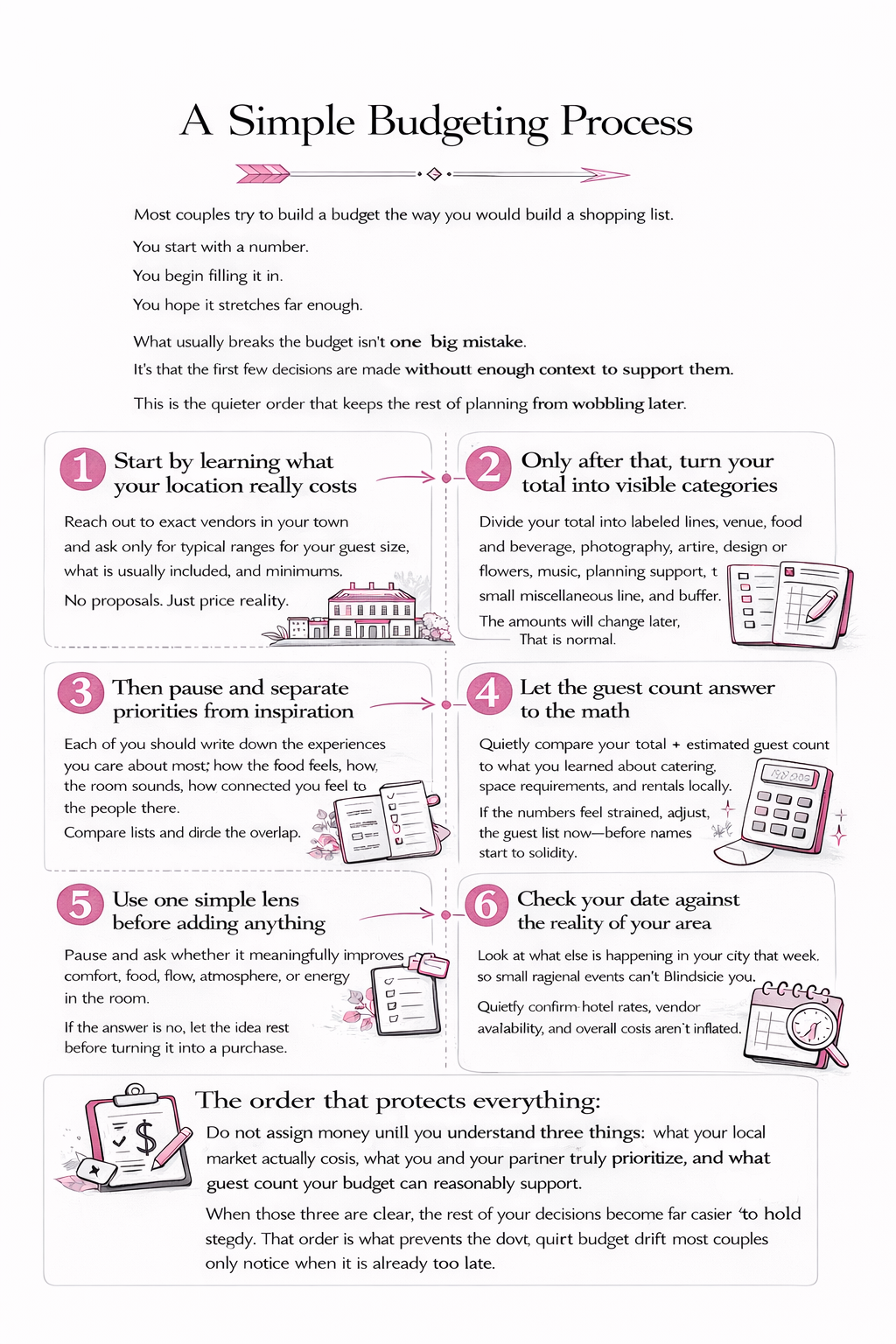
Most couples try to build a budget the way you would build a shopping list.
You start with a number.
You begin filling it in.
You hope it stretches far enough.
What usually breaks the budget isn't one big mistake. It's that the first few decisions are made without enough context to support them.
Before you tour another venue, know the real minimum you're working with.
The Wedding Venue Minimums Tracker → see the tool
Start by learning what your location really costs
Before you touch your total, spend a short window of time gathering price reality in your own area.
Not every category yet.
Just the ones that quietly set the floor for everything else.
Look first at your venue, your catering (or venue plus catering if it is bundled), your photographer, and your floral or design support.
Reach out to two or three vendors in your actual town or region and ask only for their typical range for your guest size, what is usually included, and whether they have minimums.
You are not requesting proposals.
You are learning what kind of wedding your market supports.
At the end of this step, you should simply have a small list of real ranges — nothing more complicated than that.
Then pause and separate priorities from inspiration
This part is easier if you do it quietly and separately.
Each of you should write down the three parts of the day you care about most.
Not vendors.
Not visual details.
Not ideas you saved online.
Experiences.
How the food feels.
How the room sounds.
How connected you feel to the people there.
How present you are during the day.
When you compare your lists, pay attention to what overlaps.
Those shared priorities become the emotional anchors for your budget.
They quietly tell you where your money should work hardest.
Only after that, turn your total into visible categories
A single number feels clean, but it hides the real decisions.
Instead, divide your budget into named areas — venue, food and beverage, photography, attire, design or flowers, music, planning support, a small miscellaneous line, and a buffer.
The amounts will change later.
That is normal.
What matters now is that every decision has a place to land.
This is how trade-offs stay visible instead of disappearing inside one large total.
Let the guest count answer to the math
If this is the moment your numbers start to feel unclear, it’s usually not the math — it’s the order behind it.
The order behind it is the problem.
This is also the point most couples reach too late.
Take your total and divide it by your estimated guest count.
Then quietly compare that number to what you just learned about catering, space requirements, staffing and rentals in your area.
If the numbers feel strained, the guest list is usually the part that needs adjusting — not the budget categories.
It is much easier to make this change now, before names and expectations start to solidify.
Before you tour another venue, know the real minimum you're working with.
The Wedding Venue Minimums Tracker → see the tool
Use one simple lens before adding anything
Later, when you are tempted to upgrade or add something, pause for a moment and ask whether it meaningfully improves how the day feels for people.
Comfort.
Food.
Flow.
Atmosphere.
Energy in the room.
If the answer is no, it is often worth letting the idea rest before turning it into a purchase.
This single question quietly protects your budget from detail creep.
Check your date against the reality of your area
Before you lock a date, take ten minutes to look at what else is happening locally during that week.
Search for festivals, tourism peaks, holiday weekends and nearby college sports schedules.
Even small regional events can push hotel rates up, tighten vendor availability and quietly increase overall costs.
You are not looking for perfection.
You are simply confirming that your date is not working against you.
Track only decisions, not possibilities
Your budget should reflect commitments — not ideas.
Record deposits.
Signed contracts.
Confirmed totals.
Each time something is booked, update the category it belongs to.
This keeps your numbers grounded in reality instead of optimism.
Planning feels scattered because no one shows you the full picture.
Most budgets don’t collapse from overspending.
They collapse from sequence.
Money gets assigned before reality is understood.
Before you allocate a dollar, three things must be clear:
• what your local market actually costs
• what you and your partner truly prioritize
• what guest count your budget can realistically support
Not in theory. In numbers.
When those are defined, decisions stop drifting.
Without them, every choice competes with the next.
That’s how couples quietly end up $5,000 — sometimes $15,000 — past where they meant to land.
Not from extravagance.
From order.
Once you see how much of your budget is shaped by sequence — not effort — the question shifts.
Planning isn’t about tracking more.
It’s about deciding in the right order.
Most budgets don’t break because of overspending.
They break because decisions are made without enough context to support them.
When the sequence is clear — what to decide first, what informs what — the numbers stop drifting.
If the numbers already feel slightly off, this is usually where it started.
Not with spending.
With sequence.
Before you tour another venue, know the real minimum you're working with.
The Wedding Venue Minimums Tracker → see the tool
If you want to see the full structure — how every decision connects and what actually belongs first — you can explore The Calyx Wedding Collection here
— Sara
Calyx & Cabana™
Related Articles:
Why Most Couples Overspend on Their Wedding Before the First Vendor Is Booked
A Simple Wedding Budgeting Process That Actually Holds Together
7 Budget Mistakes That Are Quietly Wrecking Your Wedding Plans
The 4 Wedding Planning Mistakes That Cost Couples the Most Money (None of Them Are What You Think)
Your Wedding Budget Isn't Broken — But the Way You Built It Might Be
