What to Ignore When You First Start Planning Your Wedding (And What Actually Matters)
The week after we got engaged, my inbox looked like it had been attacked by a very enthusiastic wedding industry algorithm.
Venue booking timelines. Photographer deposit deadlines. "You should already have your florist if you're getting married in the next 18 months." A checklist from a wedding blog that started at month 24 and made me feel like I was already behind — before I'd even told my grandmother.
Sound familiar?
Here's what nobody says loudly enough in those first few weeks: most of that noise isn't for you. It's for everyone. And "everyone" is not planning your wedding.
If everything already feels urgent, it’s usually not because there’s too much to do.
It’s because nothing has been placed in order yet.
Before you tour another venue, know the real minimum you're working with.
The Wedding Venue Minimums Tracker → see the tool
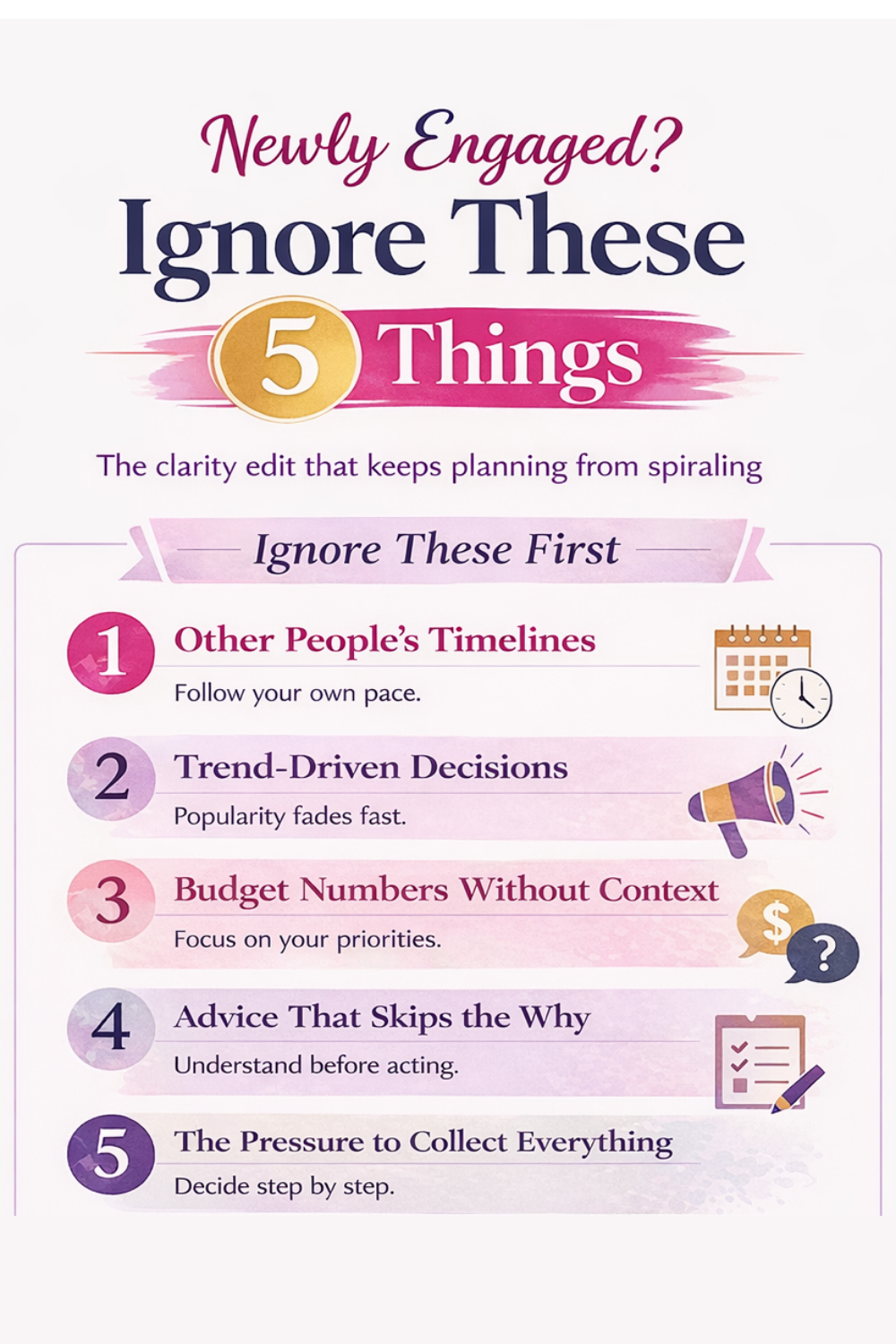
The Permission Nobody Gives You
You are allowed to ignore things.
Not because you're disorganised or cavalier about your wedding. But because the ability to filter what actually matters — for your wedding, your relationship, your priorities — is the skill that separates couples who plan with clarity from couples who plan in a constant low-grade panic.
I know a couple who spent the first three months of engagement deep in venue research. Spreadsheets, site visits, enquiry emails, comparison docs. They were thorough. They were organised. They were also doing step four before they'd done steps one, two, or three — and by the time they realised their vision and their guest list didn't match the venues they'd fallen in love with, they'd lost deposits and two weekends they couldn't get back.
They weren't doing anything wrong. They were just doing things in the wrong order.
Before you tour another venue, know the real minimum you're working with.
The Wedding Venue Minimums Tracker → see the tool
The Five Things Worth Ignoring First
1. Other people's timelines
There is no universal rule about what you should have booked by now. I promise. That blog post telling you your caterer should be confirmed 18 months out was written for a different wedding in a different city with a different budget and a different guest list.
A couple I know got engaged in January and got married the following October. Ten months. They booked everything they needed, had a beautiful wedding, and spent zero time in a panic — because they decided what mattered to them first and worked backwards from there. Meanwhile, another couple I know started planning 26 months out and still felt behind the entire time because they were following someone else's sequence.
Your timeline is the one that works for your wedding. Full stop.
2. Trend-driven decisions
If the only reason you're considering something is because it's everywhere on Pinterest right now, pause.
Acrylic signage was everywhere in 2021. Dried pampas grass. Candle forests. Ghost chairs. None of these are bad — but if you're choosing them because they're trending rather than because they genuinely feel like you, you'll look at your photos in ten years and feel vaguely confused about who that couple was.
One bride told me she spent $1,200 on a neon sign for her reception because she'd seen it on six mood boards. On the day, it felt completely disconnected from everything else she'd chosen. It's not in any of her favourite photos. She wishes she'd spent that money on literally anything else.
Trends create noise. Your taste creates a wedding.
3. Budget numbers without context
Please stop reading viral "average wedding cost" articles. I'm begging you.
They will either make you feel like you're drastically underspending (panic) or drastically overspending (different panic) — and neither reaction is useful because those numbers have nothing to do with your guest count, your city, your priorities, or your actual life.
A couple in regional Victoria will have a completely different financial reality from a couple getting married in central London or downtown New York. A wedding for 40 people is a completely different financial structure from a wedding for 140. Averages flatten all of that into a number that applies to nobody specifically.
What matters is how your priorities are structured — not what strangers spent on their wedding in a different context entirely.
4. Advice that skips the why
"Book your photographer first." "Lock in your venue before anything else." "Send save the dates no later than six months out."
All of these might be right for your wedding. Or none of them might be. The problem is that advice without context is just instruction — and following instructions without understanding why leads to decisions that feel hollow later.
When a friend told me she'd been told to book her band before her venue because "good bands go fast," she almost signed a contract for a band she'd seen once, in a venue she hadn't confirmed yet, for a guest count she hadn't finalised. Because the advice skipped the part where you need a venue before you know if a band even fits.
Understanding comes before action. Always.
5. The pressure to have it all figured out at once
You do not need every idea, every vendor shortlist, every Pinterest board, every checklist, and every opinion simultaneously.
Planning works like building a house — you need the foundation before the walls, the walls before the roof. Trying to do all of it at once doesn't make you efficient. It makes the whole structure unstable.
One couple I know created seventeen separate planning documents in their first month of engagement. Venue options, florist inspo, colour palettes, ceremony readings, honeymoon destinations, seating chart ideas — for a guest list they hadn't confirmed yet, in a venue they hadn't booked, for a date they hadn't set. By month two they were so overwhelmed they nearly postponed the whole thing.
You need the next decision. Not all of them.
This is the part most people aren’t given.
Not more steps — just the first one.
Before you tour another venue, know the real minimum you're working with.
The Wedding Venue Minimums Tracker → see the tool

What to Focus on Instead
Early planning isn't about doing more. It's about doing less — but in the right order.
The couples who look back on their planning experience and say "honestly, it wasn't that bad" aren't the ones who had the biggest budgets or the most help. They're the ones who got clear on what mattered early, made those decisions first, and let everything else fall into place around them.
That's the difference between feeling calm and feeling in control. And it's available to you — not because you need to slow down, but because you need a sequence.
If planning feels like too many things at once, it’s usually not the workload.
It’s the lack of sequence.
Before you tour another venue, know the real minimum you're working with.
The Wedding Venue Minimums Tracker → see the tool
If you want to see the full structure — how every decision connects and what actually belongs first — you can explore The Calyx Wedding Collection™ here
—Sara
Calyx & Cabana
