The DIY Wedding That Cost More Than the One They Were Trying to Avoid
I want to talk about DIY weddings. Not to discourage them — I have seen some truly spectacular ones. But I want to talk honestly about what DIY actually costs, because the story the internet tells is not the whole one.
The story the internet tells is: do it yourself and save thousands.
The story I have watched play out, again and again, is rather different.
Not sure what your wedding should actually cost? Get a realistic number in under 2 minutes. 👉 Try the free Wedding Budget Calculator
The DIY tax is real and nobody is charging you for it up front.
Here is what DIY actually costs that nobody puts in the budget.
Time.
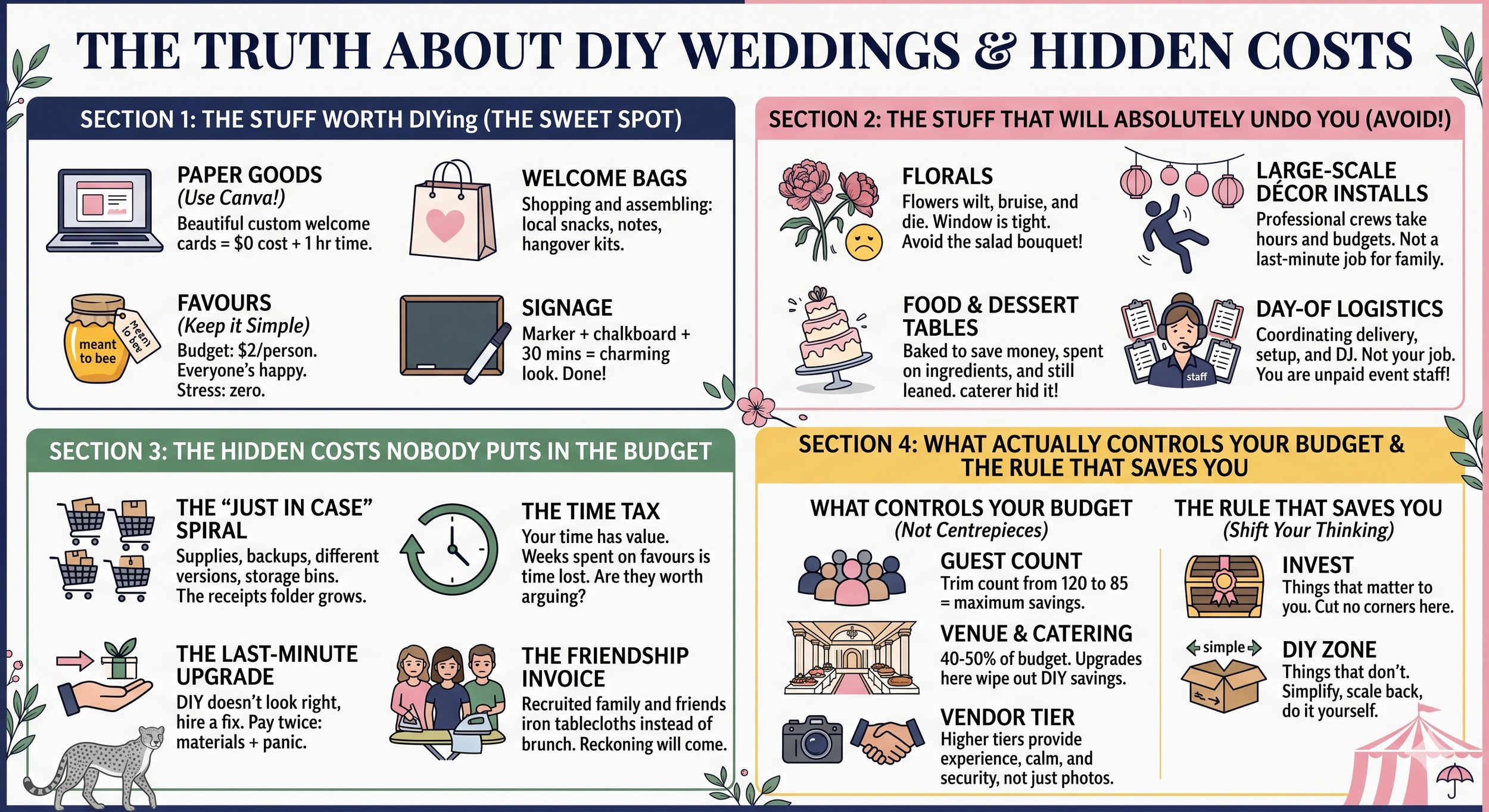
Your time has a value, even if you are not charging yourself for it. Every hour you spend making centrepieces, assembling favours, designing your own invitations, hand-lettering place cards — that is an hour you are not spending on the other forty-seven things that also need doing. And when the time runs out, as it always does, you either pay someone to finish it or you cut corners. Both cost you.
I see this happen in a particular way with invitations. A couple decides to design and print their own. They price out the paper, the envelopes, the printing, the stamps. It looks reasonable. What they have not priced in is the Saturday they spend learning design software they have never used before. The reprint when the margins are wrong. The envelope-stuffing evening that takes four hours instead of one because the flaps keep tearing. The post office trip they make twice because they underestimated the postage weight. By the time the invitations are in the mail, the savings have largely evaporated — and that was just the invitations.
Materials always cost more than the estimate.
Always. Every DIY project I have ever witnessed in the context of wedding planning came in over on materials. Sometimes slightly. Sometimes spectacularly. The tulle that needs three times as much as the tutorial suggested. The candles that need replacing because the first batch was the wrong size. The greenery that wilts before the wedding and needs to be entirely repurchased.
Here is a scenario I see play out regularly: a couple decides to make their own wedding favours. Honey jars, let's say, or candles, or something else that looks simple and personal and lovely on Pinterest. They order supplies. The first batch is not quite right — the labels don't sit flush, or the lids don't seal properly, or the scent is not what they expected. They reorder. The second batch is better but they've ordered too many of one thing and not enough of another. By the time two hundred favours are assembled, labelled, and boxed, they have spent more than a favour company would have charged — and approximately thirty hours of weekend time they will not get back.
The failure rate.
Not every DIY project works. Some things that look simple in a tutorial are not simple in reality. Some things that work perfectly in a test run fall apart at scale. The cost of a failed DIY project is not just the materials — it is the time, the panic, and usually the emergency call to a professional who charges weekend rates.
The real story of a DIY wedding I watched unfold.
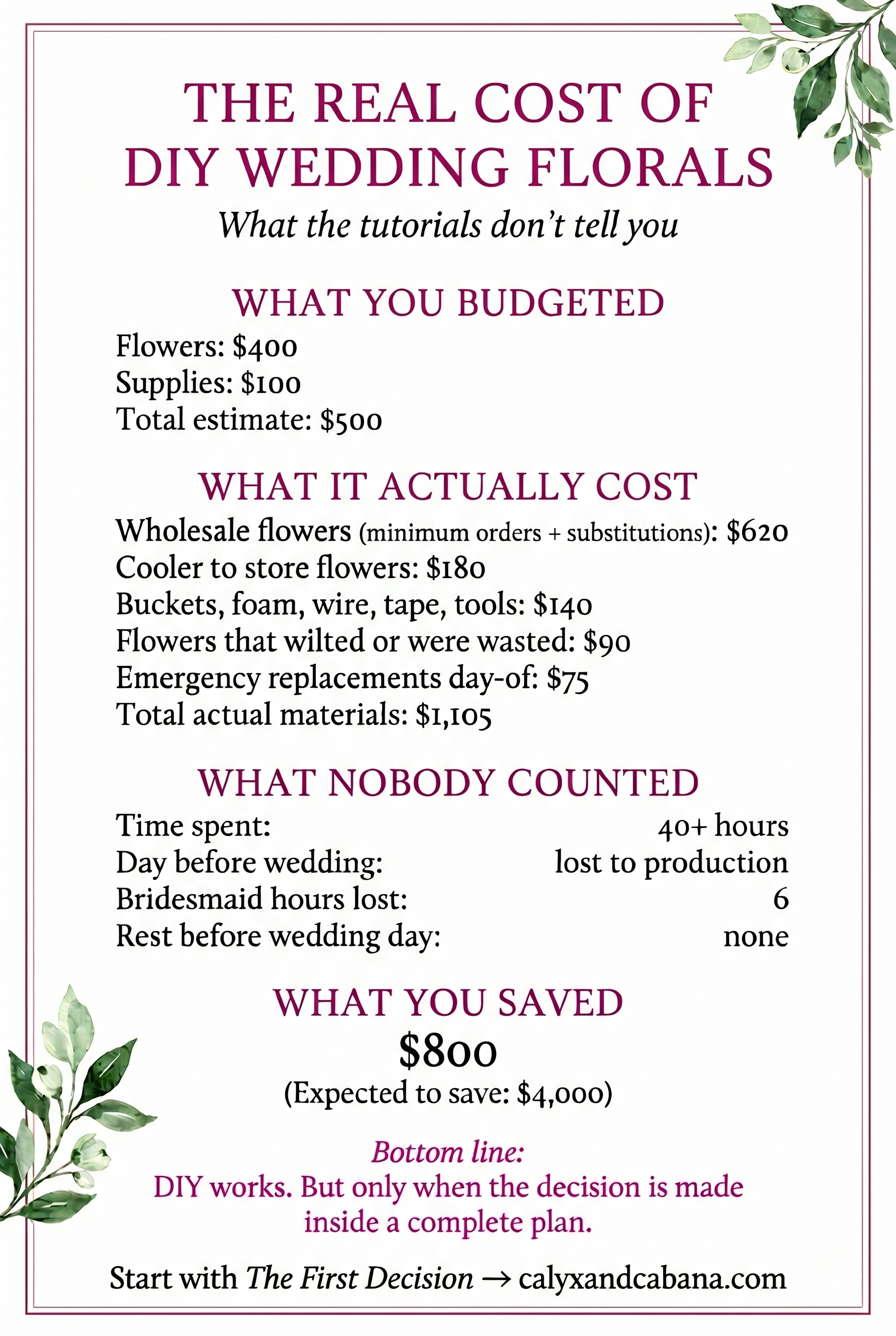
She wanted to do the florals herself. She had done a short course. She was genuinely talented. She had priced it up and worked out she would save approximately four thousand dollars compared to hiring a florist.
What she had not priced in: the cooler she needed to buy to store the flowers. The buckets. The floral tape, the wire, the foam, the tools. The flowers themselves, which cost more wholesale than she had estimated because minimum orders are real and wastage is real.
She placed her wholesale order six weeks out. When it arrived, two of the varietals she had planned around were substituted without notice — a common occurrence in the wholesale flower trade that professional florists know to plan for and first-timers do not. She spent an evening redesigning her arrangements around what she actually had.
The day before the wedding was spent entirely doing flowers instead of resting. Her kitchen became a flower studio. Her dining table disappeared under buckets and stems and ribbon. Her mother, who had flown in for the wedding, spent the day helping condition flowers instead of spending time with her daughter.
The morning of the wedding, the bouquets were not finished. Two bridesmaids stayed back to help complete them, missing part of the hair and makeup timeline. The photographer arrived to find the bride still at the worktable.
One of the arrangements — a large one intended for the ceremony arch — wilted in the afternoon heat because the flowers had not been properly conditioned. It had to be quietly removed during cocktail hour.
She saved approximately eight hundred dollars. She aged approximately eight years.
This is not an argument against DIY. It is an argument for clear decisions.
The problem was not that she did the flowers herself. The problem was that the decision was made in isolation — without a complete picture of what the wedding weekend actually required of her time and energy. Without knowing that the day before a wedding is not a production day. It is a rest day. It is the day you arrive at your own celebration with something left in reserve.
Here is another pattern I see regularly, and it is a quieter version of the same problem. A couple decides to handle their own music — a playlist instead of a DJ or band. Completely reasonable. Saves real money. But nobody thinks through who is managing the playlist during the reception. Who notices when the mood shifts and the floor empties. Who handles the moment when the speeches run long and the first dance needs to be delayed. Who fields the request from the grandmother who wants one song and the cousin who wants another. By the end of the night, someone — usually a groomsman or a well-meaning friend — has spent the entire reception staring at a laptop instead of being a guest at the wedding.
The DIY decision was fine. The surrounding decisions were never made.
Every decision you're reading about affects your bottom line. See exactly how much you have to work with. 👉 Get your free budget breakdown
A DIY wedding built on a clear foundation is a joy.
You know why you made each choice. You know what it cost and why it was worth it. You arrive at your wedding day having spent your energy intentionally.
A DIY wedding built on optimism and a Pinterest board is a very expensive and exhausting lesson.
The difference between the two is not talent. It is not budget. It is not even time. It is whether the foundational decisions were made before the DIY decisions. Whether you knew what the wedding needed from you in its entirety before you decided where to spend your energy.
The couples who do DIY well are not the most creative or the most resourceful. They are the ones who decided clearly. Who looked at the full picture of the wedding weekend and said — this part I will do myself, and here is exactly why, and here is what I am protecting by doing it. That is a completely different decision than "I will do it myself to save money." One comes from clarity. The other comes from hope.
Hope is not a planning strategy.
The First Decision exists for exactly this moment — before the DIY decisions, before the vendor list, before the budget spreadsheet. It is the one choice that, once made clearly, tells you almost everything else you need to know. Including whether DIY is right for your wedding, and if so, which parts.
Most couples skip it entirely. They move straight to the exciting decisions — the venue, the dress, the florals — without ever establishing the foundation those decisions need to sit on. And then they find themselves three months in, having spent money and time and energy, realizing that something is off. The budget doesn't add up. The vision isn't clear. The DIY projects they committed to are taking over the entire planning process and they can't remember why they decided to do them in the first place.
The First Decision doesn't add more to think about. It does the opposite. It removes the noise. It gives you one clear starting point and from that point, everything else becomes easier to see.
It takes less than an hour. It's free. And it changes the order of everything after it.
Ready to stop guessing and see your real number? Enter your guest count and region — takes two minutes. 👉 Open the free Wedding Budget Calculator
Ready to plan the whole thing in the right order? The Calyx System™ gives you every framework, tool, and timeline — sequenced from the first decision to the last detail.
Plan beautifully, — Sara Calyx & Cabana™
