7 Budget Mistakes That Are Quietly Wrecking Your Wedding Plans
And how to stop the slow, silent financial drift before it derails the most important day of your life.
Here's the uncomfortable truth no one tells you at the engagement party: most couples don't blow their wedding budget in one catastrophic moment. There's no single villain, no one extravagant decision that breaks the bank. Instead, it happens quietly — one small compromise at a time, one "well, it's only a little more" at a time — until you're staring at a spreadsheet that looks nothing like the number you started with.
Before you tour another venue, know the real minimum you're working with.
The Wedding Venue Minimums Tracker → see the tool
The good news? Financial chaos during wedding planning is almost never about how much money you have. It's about how you plan before you spend a single dollar. The couples who sail through the planning process — who actually end their wedding weekend feeling peaceful and present rather than quietly panicked — are the ones who did their homework early, made decisions in the right order, and treated their budget like a design tool rather than a wishlist.
I've identified the seven biggest mistakes that send wedding budgets spiraling. Some of them will feel painfully relatable. All of them are completely avoidable. Let's talk about each one — and exactly what to do instead.
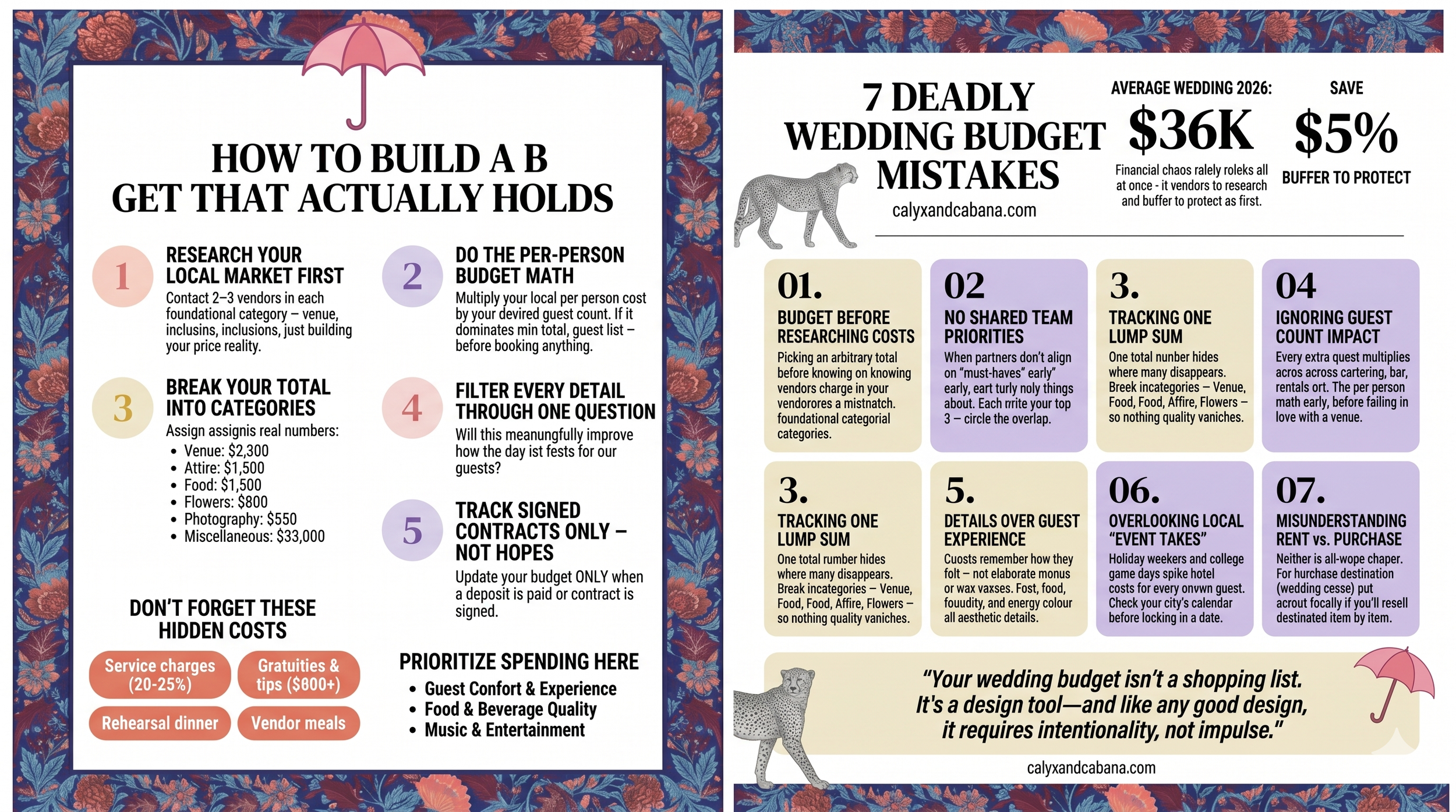
$36K Average wedding cost in 2026
5% Buffer you should always protect
3–5 Vendors to research before setting your budget
$800+ To budget just for tips & gratuities
Not sure what your wedding should actually cost? Get a realistic number in under 2 minutes. 👉 Try the free Wedding Budget Calculator

The Big Seven
Seven Mistakes, One Very Fixable Problem
Every single one of these mistakes comes down to the same root cause: making financial decisions before you have enough information. Here's what that looks like in practice.
1- Setting a budget before researching real costs
This is the original sin of wedding planning. You sit down together, pick a number that feels right — $25,000, $40,000, $60,000 — and call it your budget. The problem? That number was completely invented. You have no idea what a florist charges in your city, what your dream venue requires for a minimum spend, or what a photographer who actually knows what they're doing costs in your area. Prices vary wildly from region to region, and an arbitrary number almost always mismatches local reality. The fix is simple but non-negotiable: before you commit to a total, spend a few days gathering real price ranges from local vendors in your top four categories — venue, catering, photography, and florals. Just those four. You're not booking anything yet; you're building your price reality.
2- Failing to prioritize as a team — before anything else
Here's a pattern that plays out in engagement season every single year: two people with different ideas about what matters most start making decisions in parallel, without ever aligning on their shared "must-haves." One person says yes to an elaborate floral installation. The other books a live band. Neither of them actually cared about those things as much as they cared about, say, a truly incredible dinner and a photographer who captures real moments. The result? You've spent your budget on things neither of you will remember as clearly as the things you actually loved. Sit down together — separately from screens and vendor brochures — and each write your top three experiences. Circle where you overlap. Those overlapping items are your anchors. Everything else is negotiable.
3- Tracking one single lump sum
Operating with a single total number — "we have $45,000" — sounds simple, but it's one of the most common reasons budgets collapse. Here's why: without categories, there's nowhere for "detail creep" to hide. You add a small upgrade here, a new vendor there, a favor you saw on Pinterest that seemed affordable — and your lump sum absorbs all of it silently, until one day you realize you have $8,000 left for catering and photography combined. Break your budget into specific categories immediately: Venue, Food & Beverage, Photography, Attire, Music & Entertainment, Flowers & Design, and a buffer for the things you haven't thought of yet. When each category has its own number, you always know exactly where you stand.
4- Ignoring the enormous impact of your guest count
Your guest list isn't just a list of names. It's the single most powerful lever you have over your total budget — and most couples don't treat it that way until it's too late. Every single guest you add multiplies your costs across multiple categories simultaneously: catering, bar service, rentals (chairs, linens, place settings), and the size of the venue required to hold everyone comfortably. The math is simple and sobering. Take your total budget, divide it by your estimated guest count, and see what that per-person number looks like against what local catering actually costs. If the numbers don't work, you have exactly two choices: increase the total budget, or reduce the guest list. This is not a fun conversation, but it is a necessary one — and it is infinitely better to have it now than after you've started booking vendors.
Every decision you're reading about affects your bottom line. See exactly how much you have to work with. 👉 Get your free budget breakdown
5- Spending on details your guests will never remember
We live in an era of beautifully curated wedding inspiration, and it has made it very easy to spend a lot of money on things that look incredible in photos but contribute almost nothing to how your guests actually experience your day. Elaborate calligraphed menus. Custom wax seals on every escort card. Intricate ceremony programs that get left on chairs. These things are lovely — but your guests will not remember them. What guests remember, universally and emotionally, is how they felt. Were they comfortable? Was the food genuinely delicious? Did they dance? Did they feel the love in the room? Pour your budget into guest comfort, food quality, and the energy of the evening. Those investments pay dividends that seating chart details simply don't.
6- Overlooking what we call the "event tax"
Your wedding date doesn't exist in a vacuum. It exists in a city, in a season, in a weekend that also belongs to everyone else who lives there. Getting married during a major holiday weekend, a local festival, a university homecoming, or — in certain cities — a college football Saturday can cause hotel rates to spike dramatically for every out-of-town guest on your list. Venues can charge premium rates. Transportation becomes harder to find and more expensive. Before you fall in love with a date, spend twenty minutes checking your city's event calendar. A date that's two weekends earlier might mean your guests pay half as much for accommodation and have a much easier time getting there. That kind of logistical thoughtfulness is one of the most generous things you can do for the people you've invited.
7- Misunderstanding whether to rent or purchase
Couples often assume that purchasing items outright is always cheaper than renting — or always more expensive. The truth is more nuanced, and the right choice depends entirely on your situation. For destination weddings, renting almost always makes more sense because shipping purchased items would cost a fortune. But for local weddings, purchasing certain items — like simple geometric vases, candle holders, or specialty linens — can actually be more economical if you're willing to resell them afterward. Many couples recover 50–80% of their purchase cost by selling items through Facebook Marketplace or wedding resale groups after the day. Before you default to either approach, ask yourself: Can I resell this easily? What would shipping or transport cost? Is this a specialty item that only a rental company would stock? The right answer is different for every item.
"Your wedding budget isn't a shopping list with a ceiling. It's a design tool — and like any good design, it requires intentionality, not impulse."
Before you tour another venue, know the real minimum you're working with.
The Wedding Venue Minimums Tracker → see the tool
Ready to plan the whole thing in the right order? The Calyx Wedding Collection™ gives you every framework, tool, and timeline — sequenced from the first decision to the last detail.
→ See The Calyx Wedding Collection™
Plan beautifully,— Sara
Calyx & Cabana™
↓ Here's everything above on one page. Save it to your planning folder. Share with someone else who’s recently engaged. It will save them thousands. ↓
Related Articles:
Why Most Couples Overspend on Their Wedding Before the First Vendor Is Booked
A Simple Wedding Budgeting Process That Actually Holds Together
7 Budget Mistakes That Are Quietly Wrecking Your Wedding Plans
The 4 Wedding Planning Mistakes That Cost Couples the Most Money (None of Them Are What You Think)
Your Wedding Budget Isn't Broken — But the Way You Built It Might Be
