How to Tell If a Wedding Vendor Is Actually Worth It (Before You Book)
The Instagram portfolio was stunning.The Instagram portfolio was stunning.
Soft golden light. Candid moments that looked like they'd been lifted from a film. Couples laughing in fields, kissing under string lights, crying happy tears at altars. Every image felt like the kind of memory you'd want to keep forever.
The reviews were glowing too. Five stars, dozens of them. "Absolutely magical." "She captured everything we didn't even know to ask for." "Worth every penny."
So when Dan and Mara found her — scrolling through Instagram at midnight, two weeks after their engagement — it felt like the search was over before it really began.
They reached out. She responded within the hour.
The consultation was warm, easy, exactly what they'd hoped for. She asked about their venue, their vision, the feeling they wanted the day to hold. She seemed to understand without being told. They left the call certain.
Three thousand four hundred dollars. Paid upfront. A signed contract with a name and an email address and a phone number that, at the time, felt like more than enough.
For three months, everything seemed fine. The occasional check-in email, a reply here and there, nothing alarming.
And then, around the six-month mark, the replies stopped.
They tried the phone. Disconnected.
They tried the email. Bouncing.
They went back to the Instagram page — the one with the glowing portfolio and hundreds of followers — and found it had been quietly deleted.
What followed was the kind of unraveling that's hard to describe to anyone who hasn't experienced it. The calls to their bank. The report filed with local consumer protection. The realization, slow and horrible, that the reviews had been fabricated. The photos — that stunning, perfect portfolio — had been scraped from another photographer's account entirely.
There was no Emily with a camera and a gentle eye for light.
There was just a name, an inbox, and a disappearing act timed to happen just far enough from the wedding date to make legal recourse nearly impossible.
They found a new photographer, last minute, for nearly double the price.
She was wonderful. The photos were beautiful.
But Mara still flinches a little when she talks about those first months of planning.
"We thought we were being careful," she said. "We read the reviews. We had a contract. We just didn't know what we didn't know."
This isn't a rare story.
It's not even an extreme one, not anymore.
Vendor fraud in the wedding industry has become quietly common — not always this dramatic, not always this deliberate, but present in ways that couples rarely expect when they're still floating from the proposal.
And here's the part that makes it harder: the fraudulent vendors have gotten very good at looking exactly like the real ones.
Same aesthetic. Same warm tone. Same carefully worded bio about loving love and capturing authentic moments.
The tells are there — but only if you know where to look, and only if you're looking before you've already decided.
That's the window that matters.
Not sure what your wedding should actually cost? Get a realistic number in under 2 minutes. 👉 Try the free Wedding Budget Calculator
If you're early in the process and trying to figure out how to tell if a wedding vendor is actually worth it
— before anything is booked — it helps to start here:
There's a quiet order to wedding planning that most people aren't shown at the beginning.
And without it, even good decisions can feel uncertain.
Every decision you're reading about affects your bottom line. See exactly how much you have to work with. 👉 Get your free budget breakdown
There's a very particular kind of moment that happens before a vendor is booked.
It's usually late at night. You're on your couch with your laptop, maybe a glass of wine on the coffee table, your phone nearby with seventeen tabs open on that too. You've been at this for forty-five minutes, maybe longer. The photographers are starting to blur together.
And then one doesn't.
You pause on it.
Not in a dramatic way. Just a quiet pause.
The photos feel right. The tone feels right — something in the captions, the way they describe what they do. There's a sense, not fully formed, that this could work.
And without quite realizing it, the question shifts. It moves from Is this right? to Should I secure this before someone else does?
That shift happens quickly.
Almost invisibly.
Most newly engaged women are right here at the beginning — still floating a little from the proposal, phone full of screenshots, a vision that feels clear in some ways and completely undefined in others.
You might have a Pinterest board that's been quietly growing for two years.
You might have a venue in mind, or a color, or just a feeling you want the day to hold.
But none of it has fully translated into decisions yet.
And then you start looking at vendors, and suddenly it all feels very real — and very immediate — at the same time.
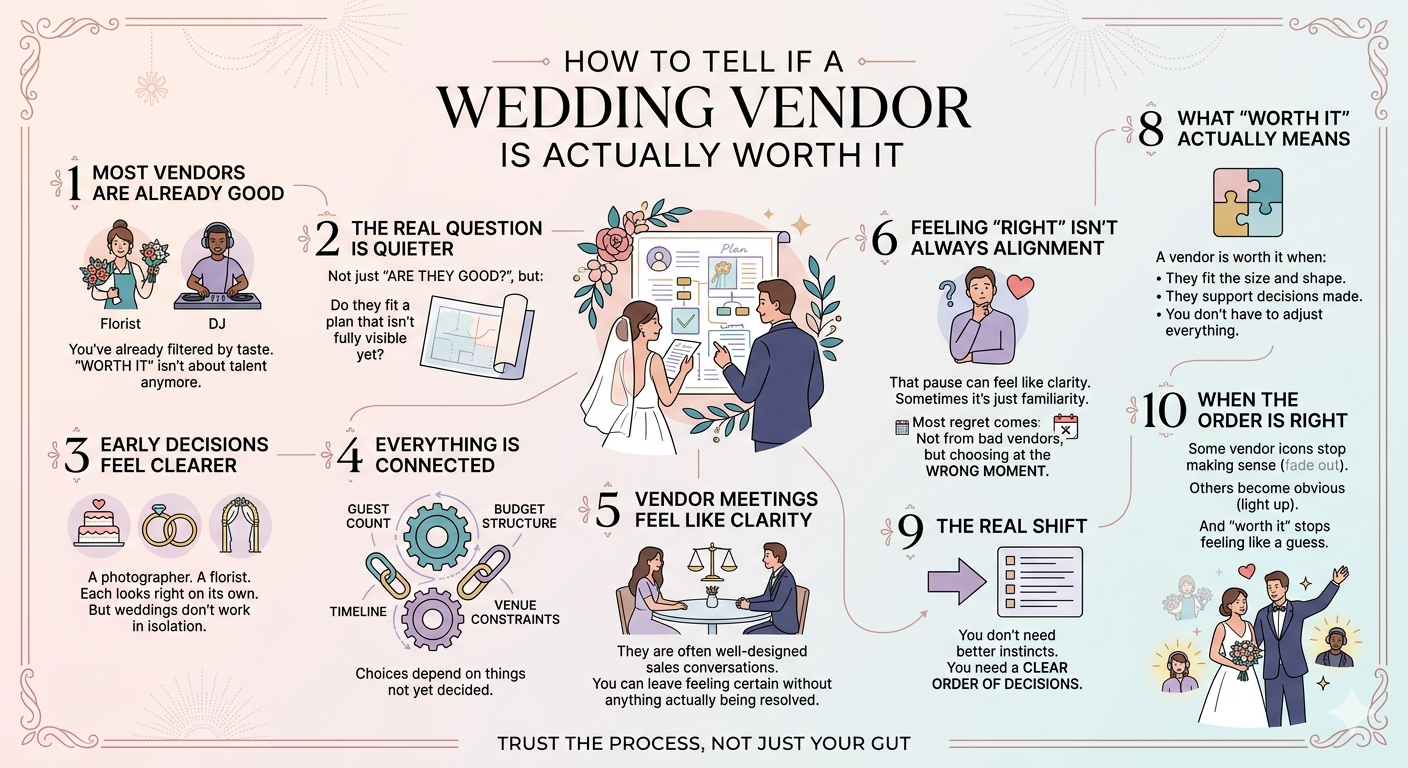
What “worth it” actually means — and what it doesn’t
When people ask how to tell if a vendor is worth it before booking, they’re usually trying to assess quality.
Is the work good enough.
Is the price reasonable.
Does this feel aligned.
Those are understandable questions.
They’re just not the ones that determine whether something is truly worth it.
Because by the time you’re pausing on someone’s portfolio, you’re not looking at the bottom tier.
You’ve already filtered by taste, by search results, by what you’re naturally drawn to.
Most vendors you’re seriously considering are already good.
So the real decision isn’t are they talented.
It’s do they fit into a structure that isn’t fully visible yet.
And that’s where things start to get much harder to read.
There’s a moment people don’t usually talk about.
You find a photographer whose work feels exactly right — not in a dramatic, overwhelming way, but in a steady, quiet recognition.
You can see your day in their images.
You open another tab to compare, but you don’t really look at it.
You go back.
That return — that small, almost unconscious movement — carries more weight than it seems.
It feels like clarity.
But it’s often just familiarity beginning to take hold.
Why early wedding planning feels deceptively clear
There’s a certain lightness to the beginning of this process.
Decisions seem contained.
A photographer is a photographer. A florist is a florist. A caterer is a caterer.
You can evaluate each one on its own.
And individually, they can all seem “worth it.”
But weddings don’t operate individually.
They operate in relationship to one another.
Your photographer’s coverage depends on your timeline.
Your florist’s pricing depends on your guest count.
Your caterer’s execution depends on your venue.
At the beginning, none of that is fully real yet.
So when you sit in that consultation and feel that warm, certain feeling — you’re making a real decision inside a structure that hasn’t fully taken shape.
That’s not a flaw.
It’s just what early planning is.
The vendor meeting is not what you think it is

There’s something here that’s rarely said out loud.
A vendor consultation is not an interview.
It’s a sales conversation.
You will often leave feeling wonderful.
You’ll have seen beautiful work. You’ll have been understood. You’ll have been guided gently toward a yes.
And you may feel like you’ve made progress.
But sometimes, very little has actually been clarified.
Imagine sitting with a caterer.
She’s warm, thoughtful, the tasting is extraordinary — small bites of things you didn’t know you loved. You can see your guests at the tables.
You leave feeling like you’ve found someone.
But you never asked how many guests she typically serves.
Her work is built around fifty-person dinners.
You’re planning for two hundred.
Nothing about that meeting was misleading.
But the reality of your wedding and the reality of her work were never placed side by side.
Or a DJ whose energy shifts the room immediately.
You book him because he feels right — lively, easy, exactly what you want.
Later, you learn the venue has a strict sound cutoff.
He’s never worked there.
The timeline compresses.
The dance floor ends before the night ever quite opens.
Again — not a bad vendor.
Just a misalignment that wasn’t visible yet.
What you’re actually doing when you think you’re evaluating
Most people evaluate vendors based on how they feel in the moment.
How much they like them.
How beautiful the work is.
How easy the conversation feels.
That’s human.
It’s also incomplete.
There’s a quieter signal that tends to matter more.
You close your laptop.
There’s a brief pause before you move on.
In that pause, there’s usually a feeling.
Not excitement exactly.
Something closer to this makes sense or I need to think harder about this.
That second feeling often gets overridden.
But it’s usually the more accurate one.
If you want something to anchor that moment — before it turns into a rushed decision
It’s a short guide, but it gives you a fixed starting point, so you’re not evaluating vendors inside a moving picture.

A pattern that shows up later
A few weeks in — sometimes a few months — something shifts.
The guest list expands.
The venue introduces constraints.
The timeline becomes real.
And one earlier decision begins to feel slightly off.
Not wrong.
Just… not fully aligned anymore.
Most of the time, this doesn’t come from choosing the wrong vendor.
It comes from choosing at the wrong moment.
What actually makes a vendor worth it
It’s quieter than most people expect.
It’s not a surge of certainty.
It’s not a feeling that you’ve found the perfect fit.
It’s a kind of steadiness.
A vendor is usually worth it when they make sense inside the reality of your wedding — not just in isolation.
When their role fits the size, shape, and priorities of the day as it’s actually forming.
When their work supports decisions you’ve already made, instead of quietly requiring you to adjust around them.
That kind of clarity doesn’t come from looking harder at the vendor.
It comes from having enough structure around your decisions to see where they land.
Where this leaves you, if you’re here now
If you’re newly engaged and trying to figure out how to tell whether a vendor is worth it before booking, you’re in a stage that often feels more defined than it is.
That’s part of the process.
What helps isn’t more options.
It’s order.
Once that order is in place, vendors tend to resolve themselves.
Some stop making sense without much effort.
Others become clear choices without needing to be justified.
You don’t need sharper instincts for this part.
You need something to place your decisions into.
It brings everything into one clear sequence, so you’re not making important decisions inside a partial picture.
That’s usually the point where “worth it” stops feeling like a guess.
And starts to feel like something you can recognize quietly.
Without urgency.
Ready to stop guessing and see your real number? Enter your guest count and region — takes two minutes. 👉 Open the free Wedding Budget Calculator
-Sara
Calyx and Cabana
Related Articles:
