The Wedding Budget Nobody Talks About: The One You Build in a Panic
I have been around weddings for longer than most of you have been alive. I have watched couples cry over spreadsheets. I have watched fathers quietly remortgage and say nothing. I have watched intelligent, capable women completely lose their minds over centerpiece costs while their entire budget quietly haemorrhaged somewhere nobody was looking.
And I am going to tell you something that the wedding industry would very much prefer I did not.
The budget conversation almost everyone is having is the wrong one.
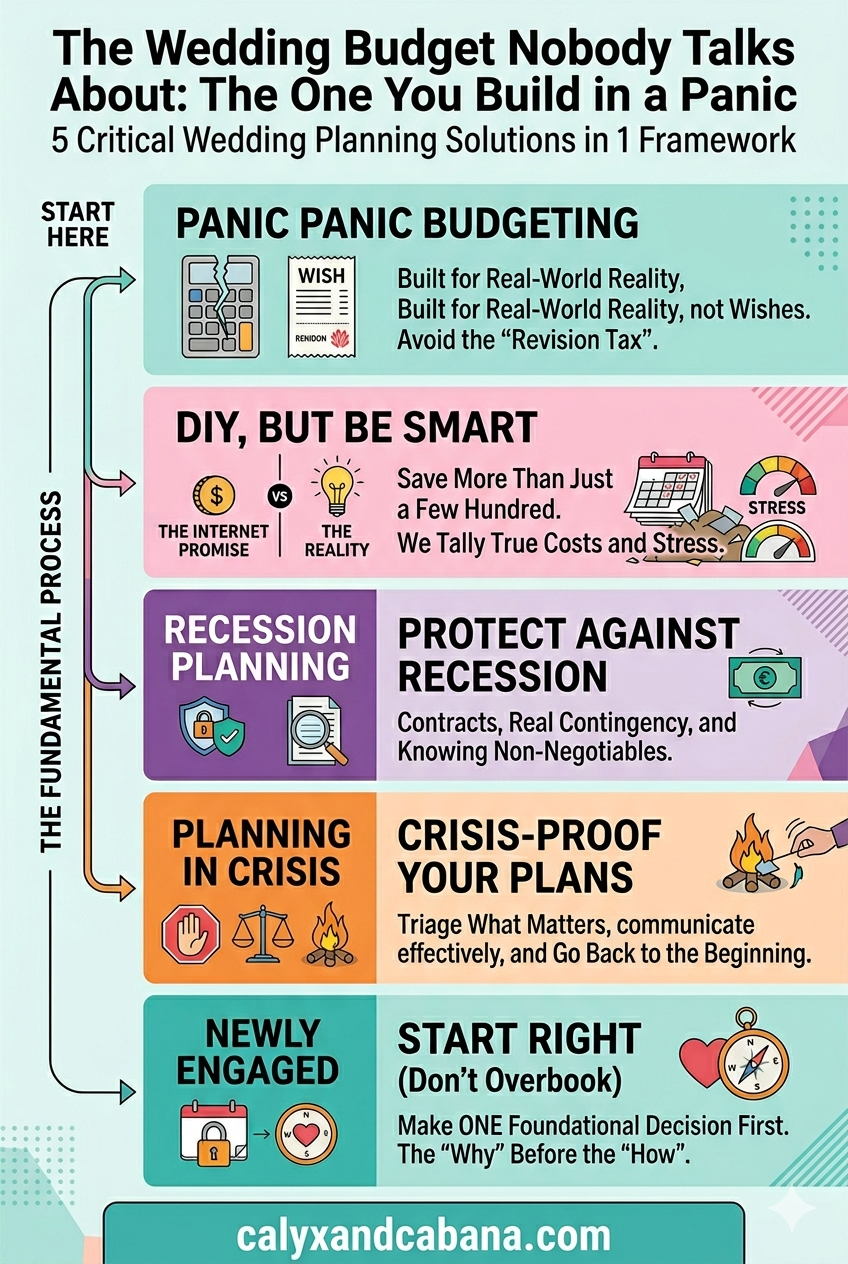
The budget you set in the first week is not a budget. It is a wish.
Here is what I see happen, over and over again, with almost every newly engaged couple I have ever encountered.
They get engaged. They are thrilled. Rightly so. And then someone — usually a parent, usually with excellent intentions — says "so what's your budget?" And because nobody wants to seem unprepared, a number gets said. Thirty thousand. Fifty thousand. Twenty-five. Whatever feels right in the moment.
And that number, said casually over a kitchen table during the engagement glow, becomes the invisible ceiling of every decision that follows.
Except it has no foundation. It is not based on what things actually cost. It is not based on how many people you are inviting. It is not based on what kind of wedding you are actually having. It is based on what felt reasonable to say out loud on a Tuesday evening.
And then the real world arrives.
Here is what a wedding budget actually needs to be built on.
Before you put a number on anything, you need to know four things. Not guess them. Know them.
First: your guest count. Not an approximation. A real working number. Because every person you add to that list is not just a seat. They are catering, they are a favour, they are a place setting, they are a portion of the venue cost, they are a slice of the cake. The guest count is the multiplier on almost every other number in your budget. You cannot set a meaningful budget without it.
Second: your non-negotiables. What is the one or two things about this wedding that you will not compromise on? The photography? The food? The band? The venue? Knowing this tells you where your budget needs to be protected and where it can flex. Without this, everything feels equally important and the budget gets pulled in seventeen directions at once.
Third: your priorities in order. Not just what matters, but what matters most. Because when the budget gets tight — and it always gets tight — you need a hierarchy. You need to know what gets cut before what.
Fourth: what you do not care about. This is the one nobody talks about. There are things in every wedding that couples spend money on because they feel like they are supposed to. Favours nobody takes home. Photo booths that get used for forty minutes. Elaborate programs that get left on chairs. Knowing what you genuinely do not care about is worth thousands of dollars.
The expensive budget mistake nobody warns you about.
It is not one big overspend. It is twelve small ones.
It is the florist revision because the original brief was vague. It is the venue upgrade because the original capacity was wrong. It is the catering adjustment because the dietary requirements were not collected properly. It is the stationery reprint because the date had a typo. It is the dress alteration that had to be done twice.
None of these are dramatic. None of them feel like mistakes when they happen. Each one feels like just dealing with something that came up.
Together they add up to the gap between what you planned to spend and what you actually spent. And that gap, in my experience, is rarely under five thousand dollars and often considerably more.
What to do instead.
Build your foundation before you build your budget. Make the decisions that your budget depends on before you put a number on anything.
I know that sounds slower. I know that when you are newly engaged and excited and everyone is asking questions, the pressure to have answers feels enormous. But a budget built on a foundation will hold. A budget built on enthusiasm will not.
The Wedding Jumpstart was built specifically for this. It takes you through the foundational decisions — the ones your budget actually depends on — before you ever open a spreadsheet. Not because spreadsheets are bad. Because a spreadsheet without a foundation is just a very organised way of tracking a problem.
Start with the foundation.
The budget follows. And when it does, it actually means something.
→ Start with The Wedding Jumpstart: [LINK]
